
So you’ve decided to customize your home or facility with motion sensors. Smart move. But now you’re staring at two options — PIR and Microwave — and honestly, it feels like choosing between two different alien languages.
Don’t stress. Let’s break it down like a friend.
Just straight talk about which sensor does what, where it wins, and where it falls flat. By the end of this, you’ll know exactly what you need.
What Even Is a PIR Sensor?
PIR stands for Passive Infrared. The name sounds fancy, but the idea is very simple.
A PIR sensor detects the heat your body releases. When you walk into a room, your body radiates infrared energy. The PIR detector picks up that shift In temperature a warm human body moving through a cooler background — and triggers a response. It could turn on a light, sound an alarm, or start recording a camera.
That’s literally it. No radio waves. No complicated signal processing. Just heat detection.
So when someone says “PIR sensor,” think of it as a motion detector that reads body heat like a thermal camera but way cheaper and way smaller.
What's a Microwave Sensor Doing Differently?
A microwave motion sensor works completely differently. Instead of sitting passively and waiting for heat, it actively sends out microwave pulses — like a tiny radar system. These pulses bounce off everything in the room. When something moves, the reflected signal changes. The sensor catches that change and fires.
The key word here? Active. It’s constantly scanning. It doesn’t care about heat. It cares about movement.
PIR vs. Microwave — The Side-by-Side Breakdown
Let’s get real about where each one shines.
Detection Method
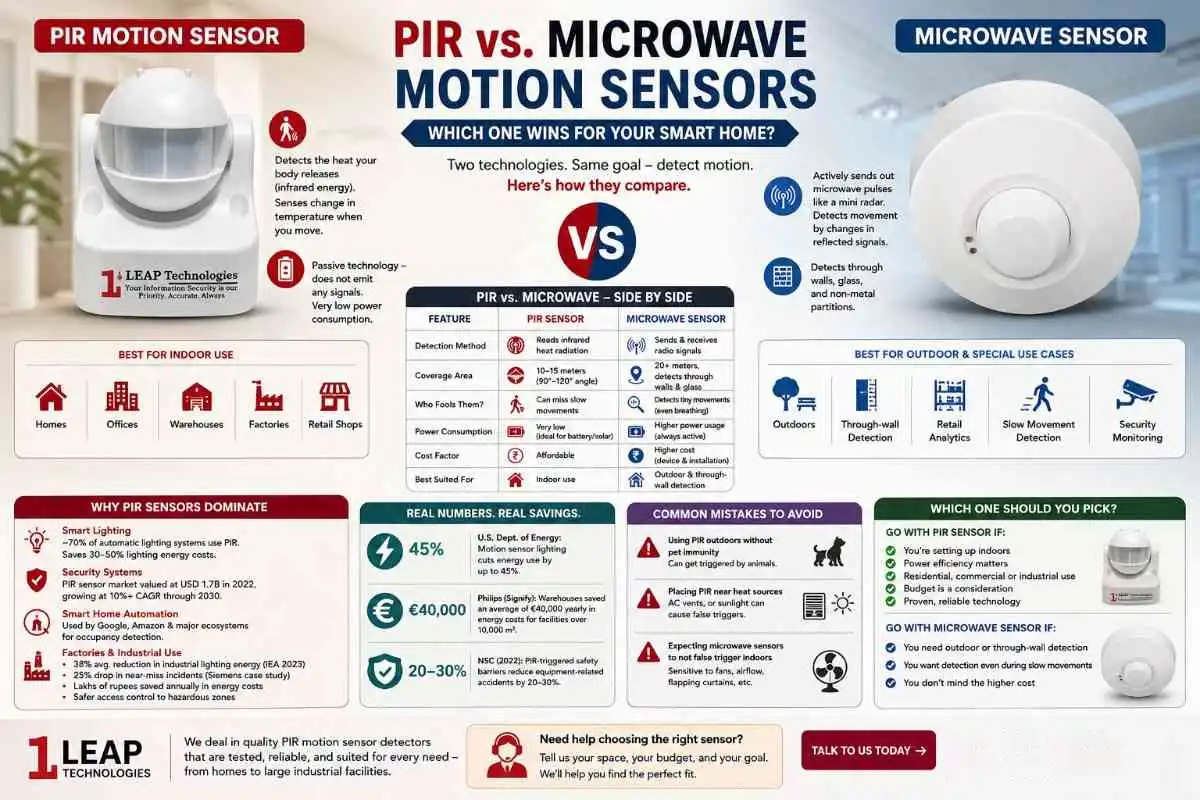
A PIR detector reads infrared heat radiation. A microwave sensor sends and receives radio signals. Both detect motion, but through completely different physics.
Coverage Area
A standard PIR motion sensor detector covers roughly 10 to 15 meters with a detection angle of 90° to 120°. Microwave sensors can push coverage up to 20+ meters and often detect through walls and glass.
Who Fools Them?
Check this out — a PIR sensor can miss you if you move very slowly. Why? Because the heat gradient changes too slowly to trigger the sensor. Microwave sensors, on the other hand, detect tiny movements. Even your breathing can trigger one if you’re close enough.
Power Consumption
PIR sensors are incredibly power-efficient. They consume almost no energy while idle, which makes them perfect for battery-powered or solar-powered setups. Microwave sensors draw more power regularly because they’re always reducing pulses.
Cost Factor
A good quality PIR motion sensor detector is majorly more affordable upfront. Microwave sensors cost more — both to buy and to install. For large-scale deployments (factories, warehouses, apartment buildings), that price gap adds up fast.
Where PIR Motion Sensors Absolutely Dominate
Honestly, PIR sensors have quietly become the backbone of smart homes, factories, and public spaces worldwide. Here’s why.
Smart Lighting
Roughly 70% of all automatic lighting systems globally use PIR detector. Walk into a parking garage, hotel corridor, or office washroom — that light flickering on as you enter? That’s a PIR sensor doing its job. Studies show buildings with PIR-based lighting controls cut their lighting energy costs by 30–50% compared to manually operated lights.
Security Systems
The global PIR sensor market was valued at USD 1.7 billion in 2022 and is projected to grow at a CAGR of over 10% through 2030. The reason? Reliability. A well-calibrated PIR motion sensor detector gives very few false alarms in a controlled indoor environment. Security companies love that.
Smart Home Automation
Google, Amazon, and virtually every smart home ecosystem uses PIR sensors for occupancy detection. They trigger thermostats, control lighting scenes, and even manage smart locks. It’s seamless when set up right.
The Factory Story — PIR Sensors Are Saving Lives and Cutting Costs
Here’s where things get really interesting. Let’s talk factories.
Manufacturing units and warehouses have adopted PIR detectors at scale — and the data backs it up hard.
A 2023 report by the International Energy Agency (IEA) found that factories using occupancy-based lighting controls (predominantly PIR-based) reduced their industrial lighting energy consumption by an average of 38%. For a mid-sized factory running 16 hours a day, that’s lakhs of rupees saved annually.
Also, worker safety. Automated PIR-based systems control access to dangerous zones in heavy machinery areas. When a worker enters a restricted zone, the PIR motion sensor detector triggers an alert or shuts down nearby equipment automatically. Siemens reported a 25% drop in near-miss incidents in one of their German plants after implementing PIR-triggered safety zones.
Plus, in cold storage facilities and food processing units, PIR sensors control ventilation and temperature management based on human presence. Less unnecessary cooling when nobody’s in the room. Huge energy savings, zero compromise on product quality.
The bottom line is — PIR sensors are not just a “home gadget.” They’re serious industrial tools driving real savings and real safety outcomes.
So Where Does Microwave Beat PIR?
Fair question. Microwave sensors have their strengths too.
They work brightly outdoors where temperature variations can confuse PIR detectors. A hot day outdoors can make it hard for a PIR sensor to distinguish a human from the warm surroundings. Microwave sensors don’t have this problem.
Also, through-wall detection. If you need to monitor activity through a partition or glass wall without placing sensors on both sides, microwave sensors can do that. PIR sensors cannot — they need a direct line of sight.
In retail analytics, microwave sensors track customer flow patterns through shelving aisles without requiring mounted sensors in every aisle. That’s a solid advantage.
Common Mistakes People Make When Choosing Sensors
Let’s talk about real-world mistakes so you don’t make them.
Mistake 1: Using PIR outdoors without pet immunity A PIR sensor triggered by your neighbour’s cat at 2 AM is not fun. Always pick a pet-immune PIR motion sensor detector for outdoor use. Most modern ones come with adjustable sensitivity to filter out smaller animals.
Mistake 2: Placing PIR sensors near heat sources An AC vent, a heater, or even direct sunlight can mess with PIR detectors. The sensor reads a warm object as a potential body. Place PIR detectors away from heat reducing sources — always.
Mistake 3: Expecting microwave sensors to not false trigger indoors Microwave sensors are so sensitive they can pick up ceiling fans, HVAC airflow, and even a flapping curtain. In smaller indoor spaces, that over-sensitivity becomes a headache.
👉 Thinking About Getting a PIR Sensor? Here’s Your Move.
At 1 LEAP Technologies, we deal in quality PIR motion sensor detectors that are tested, reliable, and suited for everything from your home hallway to a large industrial facility.
We’re not going to push you into buying something you don’t need. But if you’ve read this far, you probably have a specific use case in mind. So reach out. Tell us your space, your budget, and your goal. We’ll help you figure out exactly which PIR sensor fits — no guesswork, no overselling.
PIR or Microwave — Which One Should You Pick?
Here’s the simple answer.
Go with a PIR motion sensor if:
- You're setting up indoors
- Power efficiency matters to you
- You're covering a residential, commercial, or industrial space
- Budget is a consideration
- You want proven, reliable technology with decades of track record
Go with a microwave sensor if:
- • You need outdoor or through-wall detection
- • You want detection even during very slow movements
- • You don't mind the higher cost
For 90% of use cases — homes, offices, retail shops, warehouses, factories — a well-chosen PIR detector will do everything you need and more.
Real Numbers That Make PIR a No-Brainer for Factories
Let’s drop a few more data points because numbers don’t lie.
- The U.S. Department of Energy estimates motion sensor-controlled lighting can reduce lighting energy use by up to 45% in commercial and industrial buildings.
- A study by Philips Lighting (now Signify) found that warehouses using PIR-based occupancy controls saved an average of €40,000 per year in energy costs for facilities over 10,000 square meters.
- Industrial facilities with automated PIR-triggered safety barriers saw a 20–30% reduction in equipment-related accidents, as reported by the National Safety Council (NSC) in their 2022 workplace safety analysis.
So yeah — this isn’t just a smart home toy. A PIR motion sensor detector is a genuinely powerful tool when deployed right.
A Quick Word About 1 LEAP Technologies
We’re a dealer of PIR motion sensors — and we take that role seriously. We don’t just sell boxes. We help you figure out what actually works for your specific setup, whether it’s a single sensor for your apartment or a bulk requirement for an industrial plant.
Anyway, the reason we wrote this piece is simple — we see a lot of people buying the wrong sensor for the wrong reason. We’d rather you buy the right thing once than come back frustrated.
The Bottom Line
PIR sensors are reliable, affordable, energy-efficient, and proven over millions of installations worldwide. Microwave sensors have their niche — but for most people reading this, a quality PIR motion sensor detector is going to be the smarter, faster, and more practical choice.
So stop overthinking it.
Check your space. Identify your need. And pick the sensor that solves your actual problem — not the one with the most impressive-sounding name.
Need help choosing the right PIR detector? 1 LEAP Technologies is one conversation away.