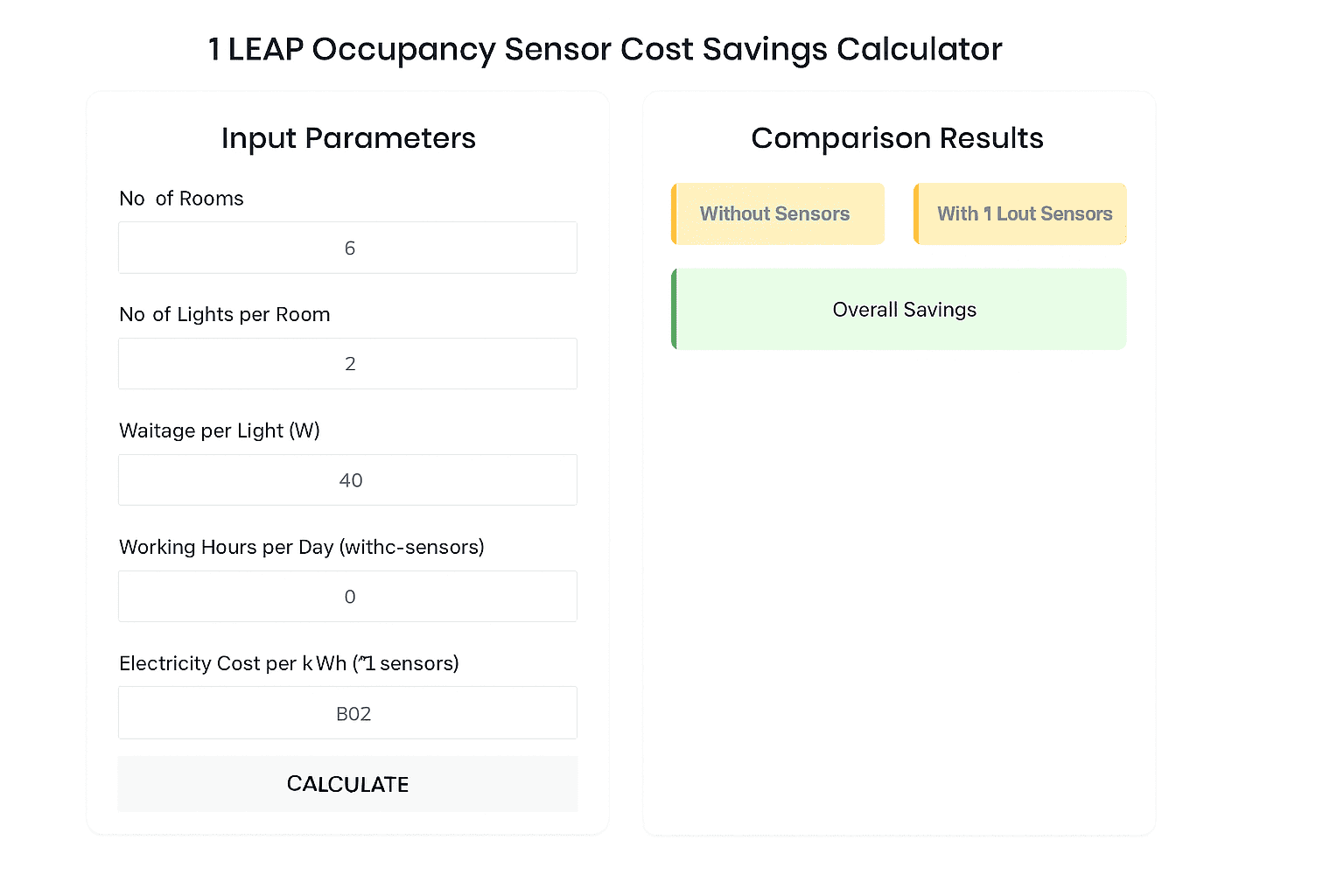

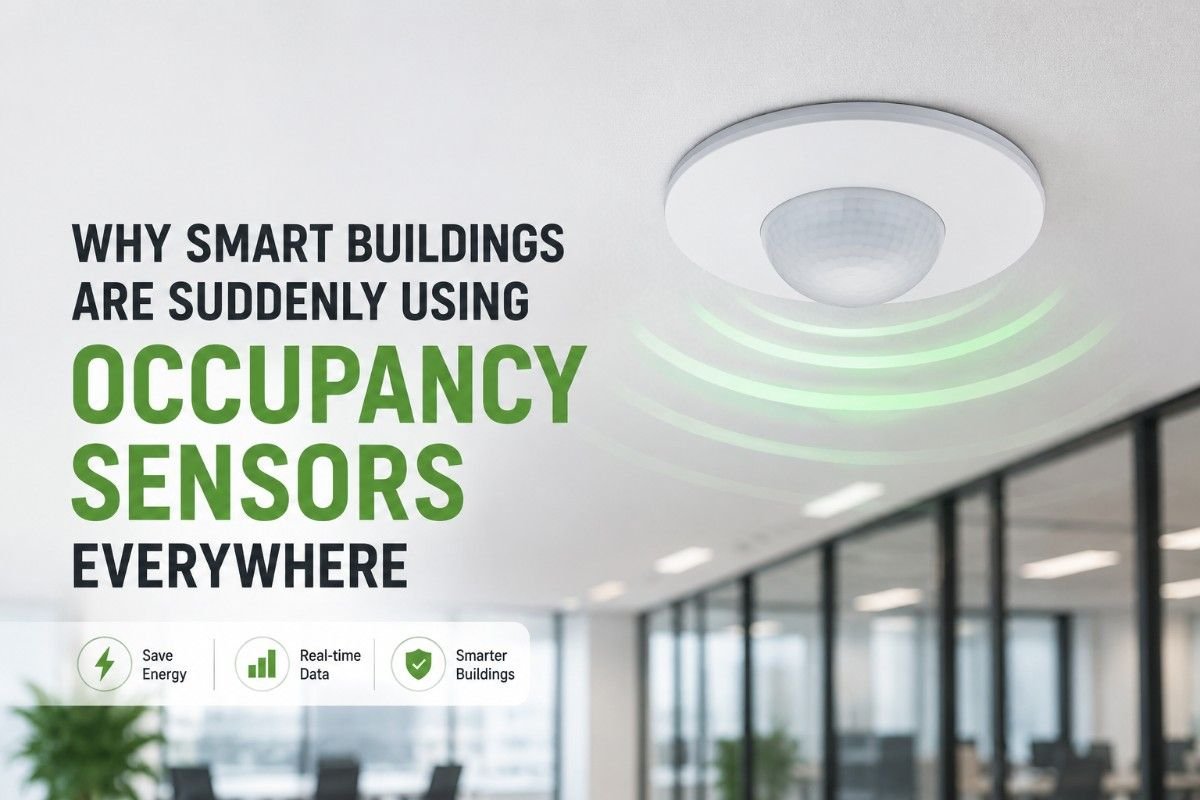
Most Buildings in today’s time are installing occupancy sensors because they reduce the wastage of energy, feeds you the real-time data into building automation, and pay for themselves. A single occupancy sensor can slash lighting and HVAC costs by 20-60% in unused spaces.
When you Walk into an almost new office tower, warehouse, or hospital wing today and you’ll spot these occupancy sensors. they’ve quietly become one of the most installed devices in commercial buildings. Honestly, if you’re a security installer or a hardware engineer who hasn’t planned one yet this year.
1 LEAP Technologies works as a dealer of occupancy sensors, and we watch this demand curve from the ground up. So let’s break down why every smart building suddenly wants these sensors wired in, how they actually work, and what separates a sensor that works for the long time from one that dies in six months.
What's Actually Happening Inside a PIR Occupancy Sensor?
A PIR occupancy sensor detects infrared heat signatures given off by human bodies. When a person moves through its field of view, the sensor’s pyroelectric element see a change in infrared radiation and triggers a switching action. Simple physics, but have huge impact.
Here’s the thing. Every warm object radiates infrared energy. A person walking through a room is basically a moving heat source for the sensor. A PIR occupancy sensor uses a pyroelectric sensor element, usually made from lithium tantalate or a ceramic pyroelectric material, split into two or more segments.
Here's how the detection cycle actually works:
A PIR occupancy sensor detects infrared heat signatures given off by human bodies. When a person moves through its field of view, the sensor’s pyroelectric element see a change in infrared radiation and triggers a switching action. Simple physics, but have huge impact.
- Passive detection — The sensor doesn’t reduce any energy itself. It just watches for the changes in infrared levels within its field of view, typically 90° to 180° depending on the lens.
- Fresnel lens segmentation — A multi-faceted Fresnel lens splits the coverage zone into multiple detection segments. This makes the sensor more sensitive to a body crossing between segments than a static heat source
- Differential signal processing — When a person moves over two adjacent segments, the two halves of the pyroelectric element pick up opposite polarity signals. The onboard comparator circuit reads this difference and fires the output.
- Time-delay hold — Most commercial units hold the “occupied” state for a programmable interval, usually anywhere from 30 seconds to 30 minutes, before going back to main menu step.
Plus, a lot of workplace occupancy sensors these days aren’t remain pure PIR anymore. Manufacturers combine PIR with ultrasonic or microwave detection and after this combination this sensor gets different name known as dual-technology Occupancy sensing. Ultrasonic elements reduce sound waves around 25-40 kHz and measure the Doppler shift when someone moves. Combining both technologies cuts down false triggers and false vacancies, which is a massive deal in open-plan offices with cubicle walls blocking direct line-of-sight.
Also worth knowing: response time on a good PIR occupancy sensor is under 0.5 seconds, and detection range on a ceiling-mount unit commonly spans 24 to 40 feet in diameter at a 9-foot mounting height. That’s the kind of spec sheet number a hardware engineer actually cares about It as It tells you an important point.
Occupancy Sensor vs Motion Sensor vs Vacancy Sensor — What's the Real Difference?
Motion sensors just detect movement and trigger an alert or light. Occupancy sensors go further — they turn things on automatically and turn them off after a settled period of time. Each sensor Is perfect for different use case.
People throw these three terms around like they’re the same thing. They’re not, and mixing them up on a spec sheet is an easy way to fail an inspection or annoy a facilities manager. Check this out:
Feature | Motion Sensor | Occupancy Sensor |
|---|---|---|
Turn-on trigger | Any detected motion | Automatic on entry |
Turn-off trigger | Timer-based, no re-check | Automatic after set period of time |
Typical use case | Security, driveways, alarms | Offices, restrooms, hallways |
The bottom line is: an occupancy sensor is the workhorse for general workplace occupancy sensors deployment because it automates both ends of the cycle.
Why Workplaces Suddenly Have Installed Occupancy Sensors Everywhere?
Three forces are driving assumption: energy codes now mandate them, hybrid-work buildings need real occupancy data to right-size HVAC, and payback periods have dropped below 18 months in most commercial modernizes.
Then there’s the hybrid-work shift. Facilities teams don’t know anymore which desks or conference rooms actually get used on a given day. So they’re wiring up the workplace with occupancy sensors not just for lighting, but to have the data also in their dashboards that show the real utilization of occupancy sensor. That data operate decisions on downsizing leased square footage, which honestly saves more money than the lighting bill ever did till now in your company.
Also, the hardware got cheap. A decent PIR occupancy sensor unit now costs a fraction of what it did ten years back, while LED retrofit lighting made the energy savings even more visible on the utility bill you see till now in your company. Plug those two trends together and you get a fast payback — most commercial retrofit projects report payback in under 18 months, sometimes as fast as 8 months in high-traffic zones like warehouses and parking garages.
What Causes Occupancy Sensors to Fail in the Field?
Most occupancy sensor fails back due to four issues: poor lens/ the field of view placement, HVAC airflow interference between sensor, inadequate hold-time programming, and low-quality pyroelectric components in the sensor.
Nobody talks about this enough, so let’s get into it:
- Bad placement and FOV mismatch. Installers mount a 360° ceiling unit where a 180° wall unit was actually needed, or they aim a sensor straight at an HVAC vent. Airflow moving over the lens creates false triggers or, worse, false vacancies, as the sensor understand that there is someone and keeps the light on.
- HVAC and thermal interference. A vent blowing cold air over the Fresnel lens can mimic a body-sized thermal gradient. This is one of the top complaints hardware engineers report on commissioning day, so try to not place your sensor at these type of locations.
- Poor hold-time tuning. If the time delay is set too short, lights or HVAC shut off on someone sitting still — a “still-body” says, false-off. Too long, and you lose energy savings entirely. There’s a real balance here, and a lot of installers just leave it on factory default, which is almost never right for the actual room.
- Cheap pyroelectric elements. Low-grade sensors use pyroelectric material that drifts with ambient temperature swings. Over an operational lifespan of roughly 100,000 to 500,000 switching cycles, a low-quality unit can lose 15-20% sensitivity, while a properly rated commercial-grade sensor holds calibration through its full rated life.
How Do You Actually Evaluate a Quality Of an Occupancy Sensor?
Check detection range of the sensor, field of view coverage, switching cycle rating, IP rating for the install environment, and whether it’s dual-tech or single PIR motion sensor.
Here’s a buyer’s checklist we walk installers through constantly:-
- Detection coverage — Match the field of view (90°, 180°, or 360°) to the actual room geometry, not the catalog default view.
- Switching cycle life — Look for a minimum rated life of 100,000 mechanical/electronic switching cycles for commercial-grade duty.
- Contact/relay rating — For sensors driving relay loads directly, confirm contact resistance stays under 100 mΩ and the relay is rated for the connected load type (resistive vs inductive).
- IP rating — IP44 minimum for damp locations like restrooms or loading docks; IP65 for outdoor or industrial floor applications.
- Dual-tech option — For open offices or spaces with obstructions, dual-tech (PIR + ultrasonic) massively cuts false vacancy shutoffs.
Plus, always ask for the datasheet’s ambient operating temperature range. A sensor rated only for 0°C to 40°C has no business in an unconditioned warehouse in Texas or Minnesota.
A Quick Word on Door Magnetic Switches
1 LEAP Technologies also manufacturer door magnetic switches alongside our occupancy sensor, and it’s worth a quick mention here because the two often get specified together on the same job. Factory owners depends on magnetic door switches to trigger interlocks on machine guarding doors, . Real-world data from industrial safety reporting shows that the door-interlock switches, magnetic reed types especially, cut unauthorized machine access incidents useful majorly in plants that retrofit them onto existing enclosures. Workers get an extra layer of protection, and plant managers get an audit trail showing exactly when a panel or gate was opened or closed and how much time in a day it opens and closed. It’s a small component, but it does a lot of heavy lifting in factory regarding to safety compliance.
FAQ
Q1: How long does a PIR occupancy sensor typically last?
A commercial-grade PIR occupancy sensor rated for 100,000+ switching cycles typically lasts 8 to 10 years under normal daily use before sensitivity drift becomes noticeable.
Q2: Can occupancy sensors work with existing wiring, or do I need new cabling?
Most occupancy sensors are designed as line-voltage replacements for standard wall switches or ceiling junction boxes, so they work with existing 220V wiring in the majority of commercial buildings.
Q3: What's the difference between single-technology and dual-technology occupancy sensors?
Single-tech uses only PIR (infrared motion). Dual-tech combines PIR with ultrasonic or microwave detection, which reduces false shutoffs in rooms with obstructed sightlines like cubicles or restroom stalls.
Q4: Do occupancy sensors actually save money, or is it marketing?
It’s real. Documented commercial retrofits show 20-60% reductions in lighting energy use depending on space type, with payback periods commonly under 18 months.
Conclusion
Occupancy sensors aren’t a trend today, they’re becoming the important factor or we say an important application in infrastructure. Whether you’re specifying a PIR occupancy sensor for a single-room or rolling out workplace occupancy sensors over a whole campus, the fundamentals stay the same — match the tech to the space, don’t skimp on cycle life, and check the datasheet before you check the price tag, as specification are more important for the perfect work flow of an Occupancy Sensor according to your conditions.