
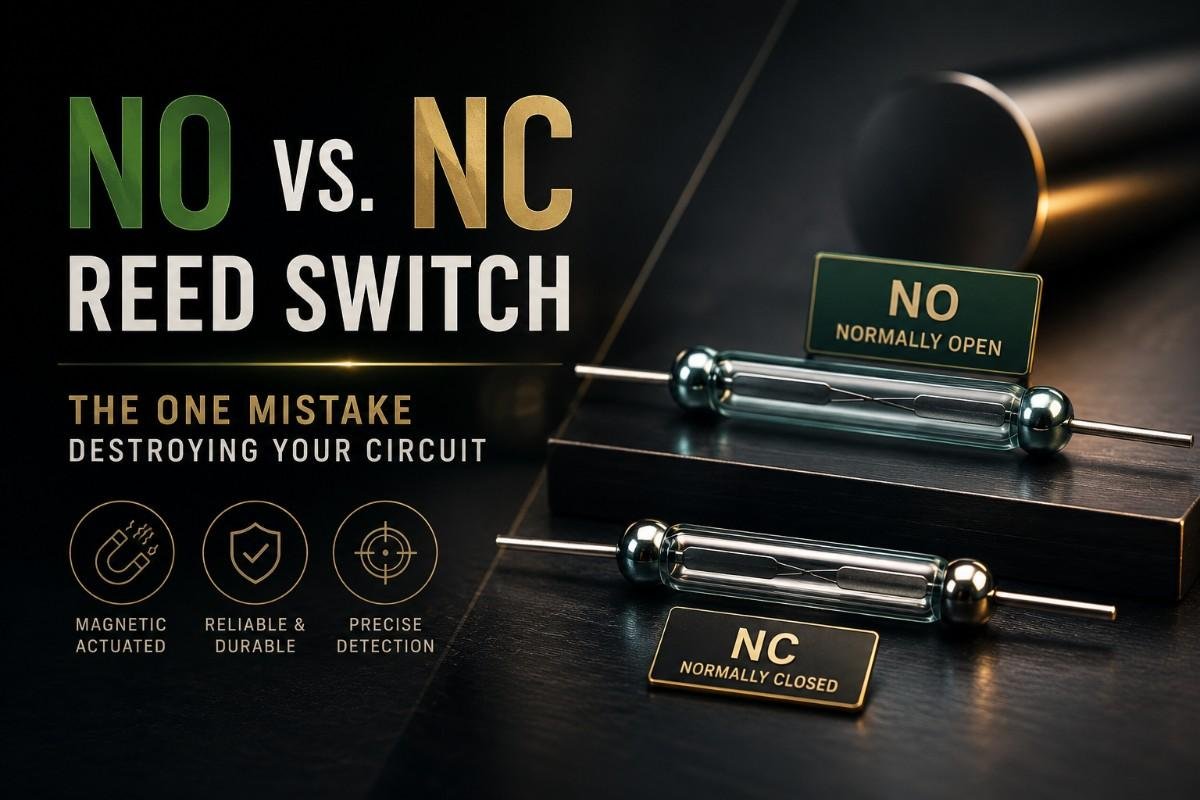
A normally closed (NC) reed switch is a magnetic switch in which internal contacts are touching and conducting electricity, when no magnet is present. Now Bring a magnet close, and the contacts pull apart, which is breaking the circuit. A normally open (NO) reed switch does the opposite: the contacts stay separated until a magnet closes them.
The mistake that wrecks more circuits than any other single wiring error is simple: engineers assume a reed switch is “off” when nothing is happening, and design the circuit around that assumption — without checking whether the switch is actually NO or NC. If you wire an NC reed switch and you are expecting NO behavior (or vice versa), your alarm won’t trigger at all, your safety interlock won’t interlock, or your counter will fire on every idle cycle instead of every active one.
You have get the contact type wrong, and the switch will still “work” — it just won’t do what you think it’s doing. That’s what makes this mistake so costly to you. There’s no error code. No smoke. Just a system that quietly fails at the one moment when it needs to succeed.
What Is a Reed Switch, and Why Does Contact Type Matter?
A reed switch is an electromechanical switch which is made up of two thin ferromagnetic metal “reeds” (blades) sealed inside a glass tube, usually filled with an inert gas or under vacuum to prevent contact oxidation. When a magnetic field crosses the switch, the reeds either attract toward each other (closing the circuit) or repel/release (opening it), depending on how the switch was made on.
The switch itself has no power source, no electronics, and no moving parts excepting only the reeds. That mechanical simplicity is why reed switches show up everywhere from door alarms to industrial cylinders as they’re durable, hermetically sealed, and cheap to manufacture at a scale.
Contact type — NO or NC, determines the default electrical state of that switch, either it is no or nc. It’s not a minor specification just written in a datasheet. It’s the single fact that decides whether your circuit is alive or dead when the magnet is absent.
NO vs. NC Reed Switch: The Core Difference
An NO reed switch is open (non-conducting) without a magnet and closes when a magnet is present near the switch. An NC reed switch is closed (conducting) without a magnet and opens when a magnet is present around the switch. Everything else — how you wire it, how you test it, and how it fails — follows from that one difference.
Property | NO (Normally Open) Reed Switch | NC (Normally Closed) Reed Switch |
|---|---|---|
State with no magnet | Open (no current flow) | Closed (current flows) |
State with magnet present | Closed (current flows) | Open (no current flow) |
Typical logic | Circuit activates when magnet arrives | Circuit activates when magnet leaves |
Common use case | Proximity detection, counting, triggering | Tamper/intrusion detection, fail-safe interlocks |
Failure-safe behavior | Wire break = switch reads as "open" (same as no magnet) | Wire break = switch reads as "open" (same as magnet present) |
That last row is where the real engineering decision based on, and we’ll come back to it.
How a Reed Switch Physically Works
Inside the glass sealed tube, the two reeds overlap slightly at their tips, separated by a small operating gap, typically a fraction of a millimeter to a couple of millimeters, depending on the switch’s sensitivity rating range.
In an NO switch, the reeds are manufactured with a slight separation and no inherent spring tension holding them together in that hermetically sealed glass tube. When a magnetic field of sufficient strength (measured in ampere-turns, AT) passes through the reeds, it magnetizes them with opposite polarity at the overlap point. Opposite poles attract, the reeds bend toward each other, and the circuit gets close. Remove the magnet, and the reeds’ own mechanical stiffness springs them back to their state.
In an NC switch, the reeds are pre-stressed so they touch at rest, held together by the spring tension made into the blades themselves. A magnet applied to an NC switch typically works by either pulling one reed away from the other using a third element or, more commonly in industrial NC designs, by re-orienting the magnetic domains so the reeds now repel rather than attract, springing the contact open. NC switches are mechanically more complex to manufacture reliably than NO switches, which is one reason NO is the more common and often cheaper variant.
Operating gap matters here too: it’s the physical distance between the magnet and the switch at which the reeds actuate. Too large a gap and the switch never trips; too small and you get false triggers from stray magnetic fields, adjacent equipment, or even the earth’s ambient field in ultra-sensitive switches.
Why the NO/NC Difference Actually Matters in Practice
This isn’t academic. Three consequences follow directly from getting it backwards:
- Silent failure in security and safety systems. A door/window alarm sensor is almost always wired NC for a reason: if someone cuts the wire, the circuit opens — and an open circuit on an NC loop reads as “breach,” triggering the alarm. If you’d used an NO switch instead, cutting the wire would leave the circuit open (which is also its normal resting state) and the alarm system would see nothing wrong. This is the fail-safe principle: NC wiring makes wire-cutting and power loss fail into the alarmed state, not the safe state.
- Wrong-logic automation counters. In an industrial line using a reed switch to count cylinder strokes or detect a part’s presence, if you assume NO logic (switch closes = part present) but you’ve actually got an NC switch installed, your PLC will count the absence of the part as the trigger event. Your counter will still increment — just backwards, at the wrong moments.
- Interlocks that don’t interlock. Machine guards and safety interlocks often use NC reed switches specifically because you want the machine to stop if the guard is opened or if a wire fails or if the switch itself dies — all of which should produce an open circuit, which the safety relay reads as “unsafe, stop.” An NO switch wired into that same logic would let the machine run in the failure scenarios it was supposed to protect against.
The pattern across all three: NC is the fail-safe default for anything where “wire breaks or switch dies” should mean “alarm/stop,” not “all clear.” NO is typically preferred where you specifically want a positive action (magnet arriving) to trigger an event, and a quiescent/idle state should draw no current.
Where NO and NC Reed Switches Are Used
NO normally open reed switches are the default choice for:
- Proximity sensing in automation (detecting a cylinder piston position, a rotating shaft, a conveyor pallet)
- Consumer and appliance applications (laptop lid sensors, washing machine door detection)
- Low-power battery devices, since the circuit draws no current until the magnet triggers it
- Counting and pulse-generation applications (flow meters, tachometers, water meters)
NC (normally closed) reed switches are the default choice for:
- Security and intrusion detection (door/window contacts, tamper switches)
- Safety interlocks on machine guards, enclosures, and access panels
- Fail-safe monitoring loops where wire integrity itself needs to be verified
- Applications where the “safe” or “alarmed” state must correspond to loss of signal, not presence of one
Key Specifications to Check Before You Select Either Type
Contact type is the first decision, but it’s not the only one. When specifying a reed switch — NO or NC — these specs determine whether it survives in your application:
- Operating gap / sensitivity (AT): The magnetic force (ampere-turns) required to actuate the switch. Lower AT means a more sensitive switch that triggers from farther away or with a weaker magnet.
- Contact rating (voltage/current): The maximum voltage and current the reeds can switch without arcing or welding shut. Exceeding this is a common cause of premature failure, especially with inductive loads (motors, relays, solenoids) that spike voltage on switch-off.
- Contact resistance: Typically very low in a new switch (milliohms range) but rises with contact wear, arcing, or contamination.
- Switching/breakdown voltage: The maximum voltage the open contacts can block without arcing across the gap.
- Operating temperature range: Reed switches are generally robust across wide temperature bands, but extreme heat can affect the glass seal and magnetic properties of the reeds.
- Housing/environmental rating: Bare glass reed switches are fragile and need a protective housing (plastic, metal, or overmolded) for most industrial or outdoor use — look for an IP rating appropriate to the environment.
- Bounce time: The brief period of contact chatter during switching, relevant in high-speed counting applications.
NO vs. NC: Advantages and Limitations
NO Reed Switch
Advantages: Draws zero current at rest, simpler and generally lower-cost construction, well suited to battery-powered and low-duty-cycle applications, intuitive “trigger on contact” logic.
Limitations: A cut wire or dead switch is indistinguishable from “no magnet present” — the system can’t tell the difference between “all clear” and “broken,” which is unacceptable in safety-critical loops.
NC Reed Switch
Advantages: Fail-safe by design — wire damage or switch failure produces the same signal as an active alarm/trip condition, so the system defaults to the safe/alerted state.
Limitations: Slightly more complex manufacturing, marginally higher typical cost, and in some low-power designs the switch’s resting “closed” state means a small continuous current draw if used in a monitored loop with a pull-down resistor.
Common Mistakes Engineers and Installers Make
- Assuming contact type from the switch’s physical appearance. NO and NC reed switches often look identical from the outside — same glass tube, same housing options. You cannot tell them apart visually. Always check the datasheet or test with a multimeter before installing.
- Wiring a security sensor as NO “because it’s simpler.” This defeats the fail-safe principle and creates a system that can be bypassed by simply cutting the wire.
- Ignoring contact rating under inductive loads. Switching a relay coil or small motor directly with a reed switch, without a flyback diode or snubber, can weld the contacts shut from the voltage spike — turning an NO switch permanently “on” or an NC switch permanently “off.”
- Not verifying the operating gap for the actual magnet being used. A switch rated for a strong magnet won’t reliably trigger with a weak one at the intended distance, and vice versa — too sensitive a switch can cause false triggers from unrelated nearby magnetic sources.
- Confusing “normally closed” with “fail-safe” without checking downstream logic. Buying an NC switch doesn’t automatically make your system fail-safe — the controller or alarm panel also has to be configured to treat an open loop as a fault condition.
How to Test Whether a Reed Switch Is NO or NC
You don’t need to guess or rely on labeling alone. With the switch disconnected from any circuit:
- Set a multimeter to continuity or resistance mode.
- Touch the probes to the two switch leads with no magnet nearby.
- Continuity (near-zero resistance) = NC. No continuity (open/infinite resistance) = NO.
- Bring a magnet slowly toward the switch and watch for the reading to flip. This also confirms the switch is functional and gives you a rough sense of its operating gap.
This 30-second check before installation prevents the exact mistake this article is about.
How to Choose Between NO and NC for Your Application
Choose NC when a wire fault or power loss must be detected as a failure or alarm condition. Choose NO when you need a low-power trigger on a positive event and fail-safe wire monitoring isn’t a requirement.
Ask these questions in order:
- Does the application involve safety or security? If yes, default to NC for fail-safe behavior, unless your system architecture already handles NO fail-safety through other means (e.g., redundant sensors, active polling).
- Is power consumption at rest a constraint? NO switches draw no current in their default state, which matters for coin-cell or solar-powered devices.
- What does the controlling system expect logically? Match the switch to the PLC, alarm panel, or microcontroller’s input logic rather than fighting it with inverted software logic, which adds complexity and a point of confusion for future maintenance.
- What’s the consequence of an undetected failure? If a broken wire going unnoticed could cause harm, lost product, or a security gap, NC is very likely the correct choice.
1 LEAP Technologies manufactures both NO and NC reed switches across multiple sensitivity and housing configurations, and can help match contact type and specifications to a given application’s fail-safe and power requirements.
FAQ: NO vs. NC Reed Switches
Are NO and NC reed switches interchangeable?
No. They have opposite default electrical states, so swapping one for the other without redesigning the circuit logic will invert the system’s behavior.
Can a reed switch be both NO and NC?
Yes — this is called a changeover or SPDT (single-pole, double-throw) reed switch, which has three leads: a common, an NO contact, and an NC contact, allowing both functions from one switch.
Which type is more common, NO or NC?
NO reed switches are more common overall due to simpler construction and lower cost, but NC switches dominate in security and safety-critical applications where fail-safe behavior is required.
Does a reed switch need external power?
NO reed switches are more common overall due to simpler construction and lower cost, but NC switches dominate in security and safety-critical applications where fail-safe behavior is required.
Can I convert an NO reed switch to behave like NC?
Not by rewiring alone — the contact behavior is a physical property of how the reeds are manufactured and pre-stressed. You’d need to replace the switch or use additional relay logic to invert the signal, which reintroduces the fail-safe problem NC switches are meant to solve.