
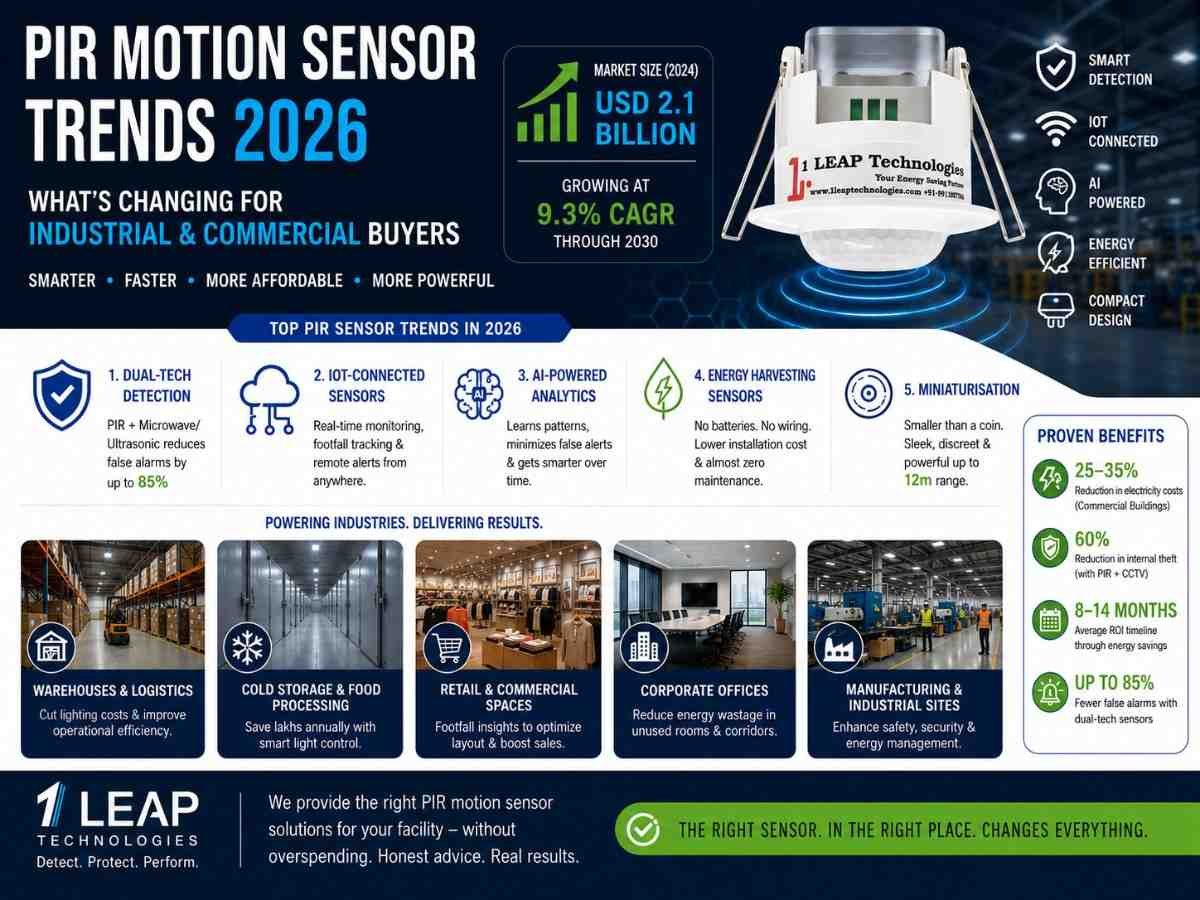
PIR sensors in 2026 are smarter, faster, and way more affordable than they were even two years ago. If you run a warehouse, factory, retail store, or any commercial space — and you’re still using old-school motion detection setups — you’re leaving serious money on the table. The global PIR motion sensor market hit USD 2.1 billion in 2024 and is growing at over 9.3% annually. That’s not hype. That’s the market telling you something is working. At 1 LEAP Technologies, we’ve been dealing PIR sensors long enough to know which trends actually matter and which ones are just noise. So let’s get into it.
Wait — Why Should You Even Care About PIR Sensors Right Now?
Honestly? Because energy costs are cruel right now.
Factories and commercial buildings waste nearly 30% of their electricity on lighting and HVAC systems running when nobody’s around. A properly installed PIR motion sensor detector fixes this problem and help you in save too much in electricity.
Check this out — a mid-size warehouse in Pune that we helped set up with a grid of PIR sensor cut their lighting bill by ₹1.8 lakh per month within 90 days of installation. No renovation. No massive overhaul. Just smarter motion detection doing its job.
So yeah, this stuff matters a lot more than people realise.
What Exactly Is a PIR Sensor
A PIR sensor — short for Passive Infrared sensor — detects heat releases by humans and animals. It doesn’t release anything itself. It just listens. When something warm moves through its detection zone, it triggers a response — lights switch on, alarms go off, cameras start recording. Whatever you’ve set it up it will start do everything.
And in 2026, that simple tech just got a serious upgrade.
Trend #1: Dual-Technology PIR Sensors Are Taking Over
Old PIR motion sensor detectors had one big problem — false alarms. A truck vibrating outside. An AC vent blowing air. Even sunlight moving through a window. All of it could trip the sensor.
So the industry said — enough.
Dual-tech sensors now combine PIR with microwave or ultrasonic detection. Both signals have to trigger together before the alarm fires. The result? False alarm rates dropped by up to 85% in industrial settings, according to field data from European manufacturing plants.
Also, these sensors work better in hard environments — dusty warehouses, cold storage units, high-heat production floors. The kind of places traditional sensors struggled with.
For industrial buyers specifically, this is the single biggest upgrade in 2026.
Trend #2: IoT-Connected PIR Sensors — Your Factory Just Got a Nervous System
Here’s where it gets exciting.
Standalone PIR sensors are fine. But IoT-integrated PIR sensors? That’s a whole different game.
Check this out — smart factories using IoT-linked motion sensors and detectors can now track foot traffic patterns over entire facilities in real time. They know which zones are high-traffic, which aisles go untouched for hours, and where bottlenecks form during shift changes.
One logistics company in Delhi used this data to restructure their floor layout and reduce worker travel time by 22%. That’s pure operational efficiency — and it came from PIR sensor data.
Also, remote monitoring means your security or facilities team gets alerts on their phone. No one sitting at a monitor 24/7. The sensor handles it.
Trend #3: AI-Powered PIR Motion Detection — Yes, Really
This one might sound like overkill. It’s not.
AI processing on PIR sensor data now allows the system to learn your facility’s normal patterns. So if the cleaning crew comes in at 11 PM every Tuesday, the system knows. No alert. But if someone walks into the server room at 2 AM on a Saturday? Instant notification.
The false positive rate in AI-enhanced PIR systems dropped to under 2%, compared to 12–15% in legacy systems. That’s a massive operational improvement for industrial buyers who were drowning in nuisance alerts.
Plus, AI systems keep getting smarter the longer they run. Your 6-month-old setup performs better than your Day 1 setup. That’s a real competitive edge.
💡 Quick Tip from 1 LEAP Technologies: Not sure which PIR sensor model fits your facility? We’ve helped businesses over Delhi, Mumbai, and Pune find the right setup without overspending. Talk to our team today — we’ll sort it out in one call.
Trend #4: Energy Harvesting PIR Sensors — Goodbye, Battery Headaches
Wiring. Batteries. Maintenance cycles. That used to be the painful reality of installing motion sensors across large facilities.
Not anymore.
Energy harvesting PIR sensors now pull power from unique sources — light, heat, RF signals. Some models run completely off the infrared heat they detect from humans nearby. No batteries. No wiring runs. You mount them and forget them.
For large commercial buildings or multi-floor industrial sites, this is a game-changer. Installation costs drop by 40–60% when you reduce wiring infrastructure. And ongoing maintenance? Almost zero.
Honestly, this trend alone is worth paying attention to if you’re planning a new facility setup or a major retrofit.
Trend #5: Miniaturisation — Tiny Sensors, Massive Coverage
PIR sensors used to be chunky. Visible. Sometimes ugly. Not a problem in a warehouse, but in retail spaces or corporate offices? Different story.
2026 sensors are smaller than a 50-paise coin in some models. Flush-mounted designs blend into ceilings and wall panels completely. You don’t see them — but they see everything.
For commercial buyers in retail, hospitality, and corporate real estate, this opens up places that were previously off-limits aesthetically. Showrooms. Hotel lobbies. Executive meeting rooms. All covered without looking like a security installation.
Plus, miniaturised sensors now carry the same detection range as older large-format models — up to 12 metres with a 110-degree field of view.
The Real-World Numbers You Should Know
Let’s talk facts. Because this stuff is backed by data, not guesswork.
- Global PIR sensor market size (2024): USD 2.1 billion — growing at 9.3% CAGR through 2030
- Energy savings in commercial buildings with PIR-controlled lighting: 25–35% reduction in electricity costs (Lawrence Berkeley National Laboratory data)
- Security improvement: Facilities using PIR motion sensor detector in combination with CCTV reported a 60% reduction in internal theft (India Retail Security Survey, 2024)
- ROI timeline: Most industrial PIR sensor installations pay for themselves within 8–14 months through energy savings alone
- False alarm reduction with dual-tech sensors: Up to 85% vs legacy single-tech models
- Adoption rate in Indian smart factories: Up 47% year-on-year from 2023 to 2025 (NASSCOM Industry Report)
These aren’t marketing numbers. These are field results.
Who's Actually Using PIR Sensors in 2026 (And Winning)
Warehouses & Logistics
Automated lighting zones triggered by PIR sensors cut operational costs majorly. Workers get bright zones exactly where they are — dark zones everywhere else. Less energy wasted. Simpler than dimmer systems.
Cold Storage & Food Processing
PIR sensors in freezer corridors prevent lights from running 24/7 in unmanned areas. One cold chain operator in Gujarat saved ₹3.2 lakh annually on just freezer corridor lighting. Simple fix. Big result.
Retail & Commercial Spaces
Footfall mapping through PIR motion sensors and detectors helps retail managers understand traffic flow, optimise staff placement, and even improve product layout decisions. It’s not just security — it’s business intelligence.
Corporate Offices
Meeting rooms with PIR-controlled HVAC and lighting reduce energy wastage in unused rooms. A 500-person office building in Bengaluru reported ₹9 lakh annual savings after a full PIR sensor retrofit across meeting rooms and corridors.
Ready to see what PIR sensors can do for your facility? 1 LEAP Technologies carries a full range of industrial and commercial PIR sensors — from basic motion detector setups to IoT-connected smart sensor networks. Get in touch with us here and let’s figure out what works for your space. No pushy sales. Just honest advice.
What to Look For When Buying PIR Sensors in 2026
So you’re sold on upgrading. Here’s what actually matters when you’re comparing options.
Detection Range & Angle
For industrial use — warehouses, factory floors — look for sensors with 8–15 metre range and a wide-angle lens (90–120 degrees). For tight corridors or entry points, a long-range narrow beam (5–8 metres, 30 degrees) works better.
IP Rating
This one is non-negotiable for industrial buyers. Get sensors rated IP65 or higher if they’re going anywhere near dust, moisture, or outdoor environments. IP65 means completely dust-tight and water-resistant. Anything lower in a factory setting is a waste of money.
Integration Compatibility
In 2026, a PIR sensor that can’t talk to your existing BMS (Building Management System) or security platform is already behind. Check for MQTT, Zigbee, Z-Wave, or BACnet compatibility depending on what your facility already runs.
Response Time
For security applications, look for sensors with under 0.5-second response time. For lighting control, 1–2 seconds is fine. Know your use case before you spec the hardware.
Tamper Detection
Honestly, don’t overlook this. High-quality industrial PIR sensors now include tamper alerts that notify you if someone covers or repositions the unit. Especially important for high-value inventory areas.
Why 1 LEAP Technologies?
Okay, quick word about us — and we’ll keep it real.
We’re a dedicated dealer of PIR motion sensors for industrial and commercial applications. We’ve been doing this long enough to know that the wrong sensor in the wrong application is worse than no sensor at all. So we don’t just sell you a box and send you off.
We help you figure out what you actually need. We’ve worked with warehouses, factories, retail chains, cold storage operators, and corporate campuses over India. The experience is real. The results our customers get are real.
And we carry sensors at every price point — from budget-friendly basic PIR motion sensor detectors to enterprise-grade IoT-integrated systems.
So whatever stage you’re at, we’ve probably helped someone in the same situation.
Conclusion
PIR sensors in 2026 aren’t just security devices. They’re operational tools. Energy management tools. Business intelligence tools. And the technology has moved so far ahead of where it was five years ago that there’s genuinely no excuse for running an industrial or commercial facility without a proper motion detection setup.
The energy savings are real. The security improvements are documented. The ROI timeline is faster than most people expect.
So if you’re still on the fence — stop overthinking it. The data is clear. The technology is proven. And the cost of doing nothing keeps going up every month.
Get your facility sorted. Your future self will thank you.
Talk to 1 LEAP Technologies Today We stock a full range of industrial and commercial PIR sensors — and we’ll help you pick the right one without overcomplicating it.
📞 Call us | 📧 Email us | 🌐 Visit our website
Because the right sensor, in the right place, changes everything.