
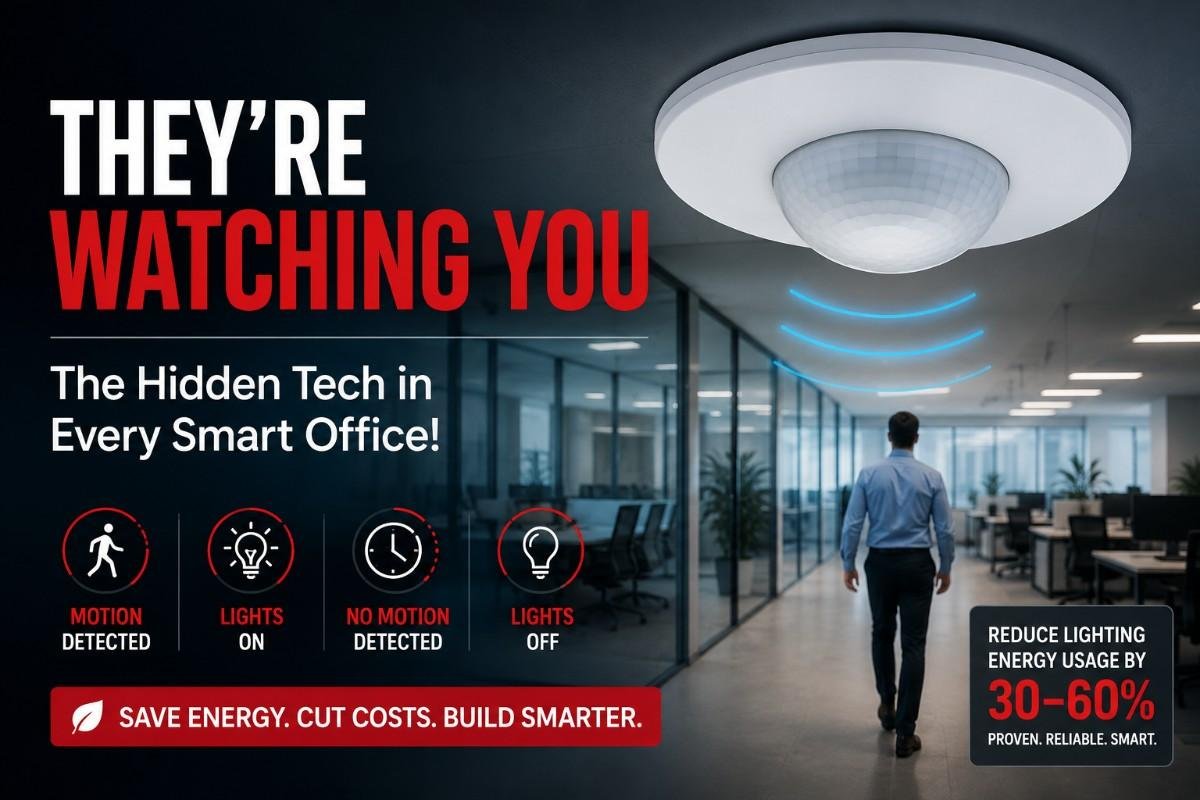
Yes, there’s a sensor watching you right now — and honestly, that’s a good thing. An occupancy sensor detects when you walk into a room and switches the lights off and on automatically, then switches them off the second you leave. No more coming back to a meeting room lit up like a stadium at 11 PM. Offices using motion sensors and detectors report lighting energy savings of 30-60%, depending on how the space gets used. That’s not a guess — that’s data from real installations. Plus, you get zero manual switches to fumble with in the dark.
So yeah. Someone (or something) is watching. But it’s not spying on you. It’s saving your company money.
Wait, What Even Is an Occupancy Sensor?
Okay, let’s back up for a second. Picture this: you walk into your office pantry at 7 AM before anyone else is in. Lights flick on. You grab your coffee and walk out. Lights flick off. Nobody touched a switch.
That’s a PIR motion sensor doing its job. PIR stands for Passive Infrared — basically, it detects body heat and movement in a room. Honestly, it sounds like sci-fi, but it’s dead simple tech that’s been around for decades.
The problem most offices have? Lights left on in empty rooms. Conference rooms nobody’s using. Storage areas lit up 24/7. It adds up. Big time. First, it wastes electricity. Then, it inflates your utility bill every single month without anyone noticing why. An occupancy sensor for lights fixes that instantly.
Wait, What Even Is an Occupancy Sensor?
Check this out — here’s what a solid PIR-based occupancy sensor actually brings to the table:
- Cuts your electricity bill fast — because lights only run when someone's actually in the room. Facilities managers commonly see savings of 30% or more within the first billing cycle.
- No manual switching, ever — you walk in, lights turn on. You leave, they turn off after a set delay. Zero effort.
- Dual Range Occupancy Sensor coverage — catches both major movement (someone walking in) and minor movement (someone sitting still at a desk typing). Big deal for open offices.
- Longer bulb life — fewer on-off cycles from human error means your fixtures last longer. Less maintenance, less replacement cost.
- Adjustable time delay settings — you decide how long lights stay on after the room goes empty. 30 seconds, 5 minutes, whatever fits your space.
- Adjustable sensitivity control — so a sensor in a warehouse aisle doesn't react differently than one in a tiny cabin.
- Wide detection range — most quality PIR units cover 800 to 2000 square feet, depending on mounting height and model.
- Works quietly in the background — no wiring drama, no complicated app setup for basic models. Plug, mount, done.
- Reduces HVAC load indirectly — fewer lights running means less heat generated, which means your AC works a little less too. Small thing, but it adds up over a year.
- Built for factory floors too — not just offices. Industrial-grade PIR sensors handle dust, vibration, and temperature swings way better than basic residential units.
- Improves safety in low-traffic zones — stairwells, storage rooms, and corridors light up the instant someone enters them. No one's fumbling for a switch in the dark.
- Pairs with existing wiring — most models retrofit into standard switch boxes. You don't need to rip your walls open.
Honestly, once you see the savings on paper, it’s hard to unsee.
For Whom This Sensor Is Perfect For (and Who Should Look Elsewhere)
Let’s be straight with you here. Not every space needs the same setup.
This is perfect for:
- Corporate offices with conference rooms, cabins, and pantries that sit empty for hours
- Factory floors and warehouses where workers move in and out of specific zones
- Retail stores with stockrooms or fitting rooms
- Schools, hospitals, and co-working spaces with high foot traffic variation
- Facility managers trying to hit sustainability or energy-compliance targets
You should probably look elsewhere if:
- Your space has constant airflow from HVAC vents right near the sensor (can cause false triggers; needs proper placement)
- You're expecting a full smart-home ecosystem with app control on a very tight budget — basic PIR units are simple, not flashy
- Facility managers trying to hit sustainability or energy-compliance targets
Honestly, we’d rather tell you upfront than sell you the wrong unit. That’s just how we operate.
How It Actually Works (Step-by-Step)
- Detection: The PIR sensor picks up infrared heat signatures from moving bodies within its field of view.
- Signal processing: The internal circuit filters out background noise (like sunlight or HVAC drafts) so it reacts to real human movement as well as animal movements.
- Trigger: Once movement crosses the sensitivity threshold, the sensor sends a signal to the relay.
- Light activation: The relay switches the connected lighting circuit on, instantly or within a fraction of a second.
- Time-delay hold: The sensor keeps lights on as long as it detects movement, plus your configured delay time after the last movement.
- Auto shut-off: No movement detected past the delay window? Lights switch off automatically. The cycle repeats.
Simple, right? No AI, no cloud dependency needed for basic models. Just solid, reliable engineering.
Real Results & Proof
We’ve installed PIR sensors over many offices, factories, and retail spaces for years now, and the feedback keeps confirming the same thing.
“We cut our monthly lighting cost in our factory unit by almost 40% within two months of switching to motion sensors and detectors. Didn’t expect results that fast, honestly.” — Rajesh M., Plant Supervisor, Pune
“Our conference rooms used to stay lit the whole weekend because someone forgot to switch off. Not anymore. The occupancy sensor just handles it.” — Priya S., Facility Manager, Ahmedabad
“1 LEAP Technologies helped us in picking the right sensor for our warehouse aisles. The dual range detection actually catches forklift operators standing still, which our old sensor missed completely.” — Vikram T., Operations Head, Surat
Industry-wide data backs this up too — commercial buildings using occupancy-based lighting controls typically report energy reductions between 24% and 73% depending on the space type, according to multiple lighting research studies over the past decade. Factory floors specifically benefit because large open areas often have the worst “lights left on” waste.
Frequently Asked Questions
Does an occupancy sensor really save that much on electricity?
Yes, it does. Most commercial spaces see savings between 30% and 60% on lighting-related electricity costs. The exact number depends on how often rooms sit empty versus occupied throughout the day.
What's the difference between a motion sensor and an occupancy sensor?
Honestly, they’re closely related. A motion sensor detects movement and triggers an action. An occupancy sensor for lights specifically uses that detection to control lighting, often with added features like time delays and sensitivity adjustment for fine motion (like someone typing at a desk).
Can PIR sensors work in factories with heavy machinery?
Yes, industrial-grade PIR units are made to handle vibration, dust, and temperature swings common on factory floors. Just make sure you pick a rated model meant for industrial environments, not a basic residential one.
What is a Dual Range Occupancy Sensor?
It’s a sensor that detects both major motion (walking, large movement) and minor motion (small movements like hand gestures or sitting still). This matters a lot in offices where someone might sit quietly at a desk for long stretches.
How long does installation usually take?
Most retrofit installations take under an hour per fixture for a trained electrician, since these sensors typically fit into existing switch boxes without major rewiring.
Will the sensor false-trigger from sunlight or AC vents?
It can, if placement is wrong. Good sensors have built-in temperature compensation, but proper mounting away from direct HVAC airflow and windows reduces false triggers instantly.
Do these sensors need Wi-Fi or an app to function?
No, not for basic models. Standard PIR occupancy sensors work independently through simple relay-based switching. Smart versions with app control exist too, but they’re optional.
How do I know which sensor fits my space size?
It depends on ceiling height, room shape, and traffic pattern, so the coverage range matters most here. As a dealer working directly with PIR motion sensor manufacturers, 1 LEAP Technologies helps match the right range and sensitivity to your actual floor plan.
Ready to Get Started?
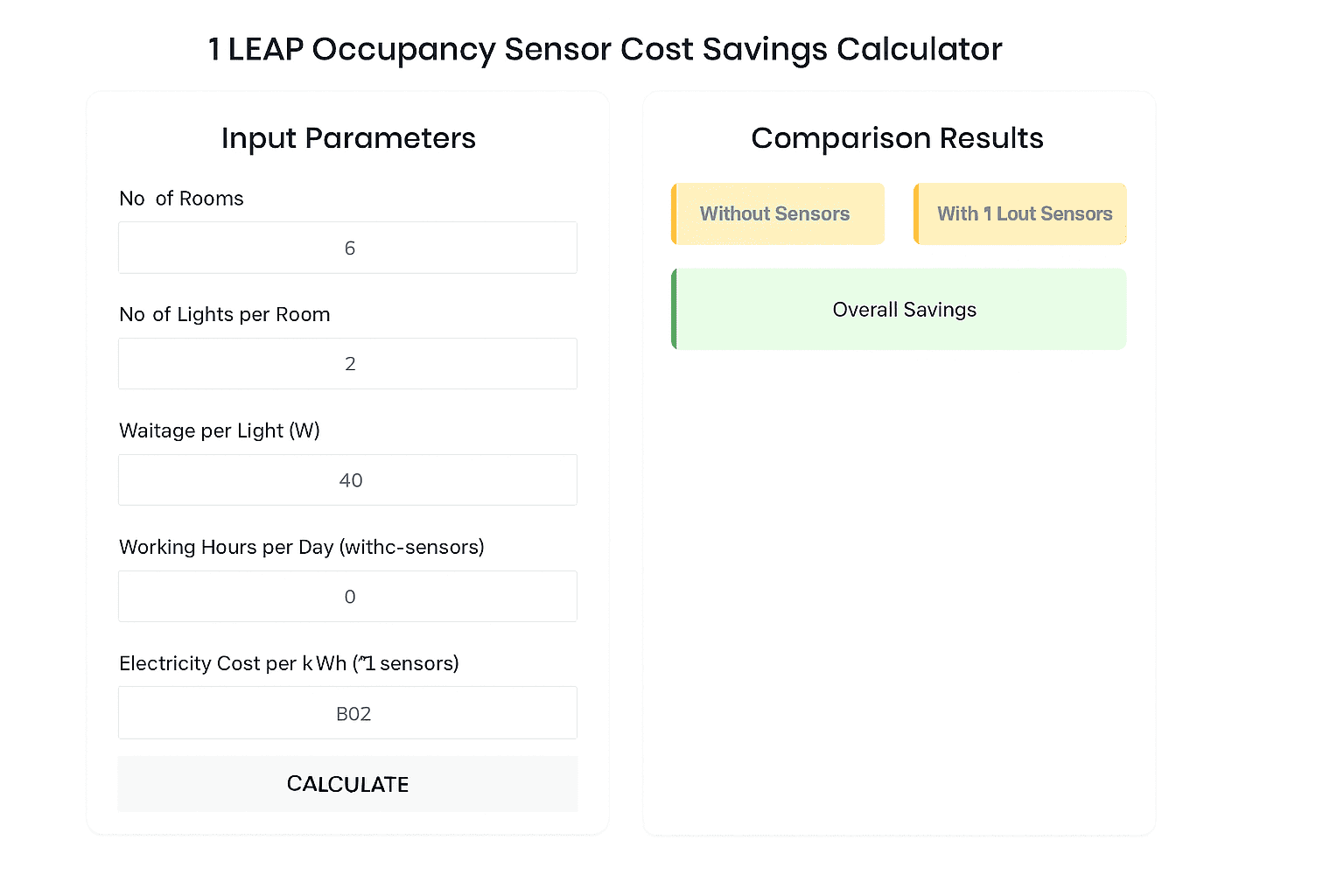
Look, you don’t need to overhaul your overall office overnight. Start with one high-traffic zone – a conference room, a factory aisle, a stockroom – and see the difference for yourself.
1 LEAP Technologies works as a dealer for PIR motion sensors, and honestly, we’ve seen enough installations to know what works where. If you’re stuck figuring out which sensor fits your space, reach out and we’ll walk you through it.
- Limited-time bonus: Ask about bundled installation guidance when you enquire this month.
- No pressure, just clarity: Tell us your space size and traffic pattern, and we’ll point you toward the right fit — even if that means a simpler unit than you expected.
Anyway, your lights shouldn’t be running when nobody’s around. Time to fix that.