

Industrial automation has changed the way factories operate. From advanced machines to automated safety systems, modern production lines depends too much on sensors and switching devices that can work accurately under demanding conditions. Among these small but powerful components, the Reed Switch comes out as one of the most trusted and hugely used technologies in automation systems.
In its tiny size, this switch plays an important role in monitoring movement, detecting positions, make sure the safety, and controlling machinery over multiple industries. When combined with a magnetic reed sensor, automation systems get a simple, durable, and highly reliable method of detecting changes in magnetic fields without direct physical contact.
At 1 LEAP Technologies, we manufacture high-quality magnetic switching components designed for industrial applications where reliability and performance are important. In this article, we will explore how the Reed Switch works, why it has become so valuable in automation, and how industries worldwide depends on magnetic reed sensors to keep their processes well-organized and safe.
Understanding the Reed Switch Technology
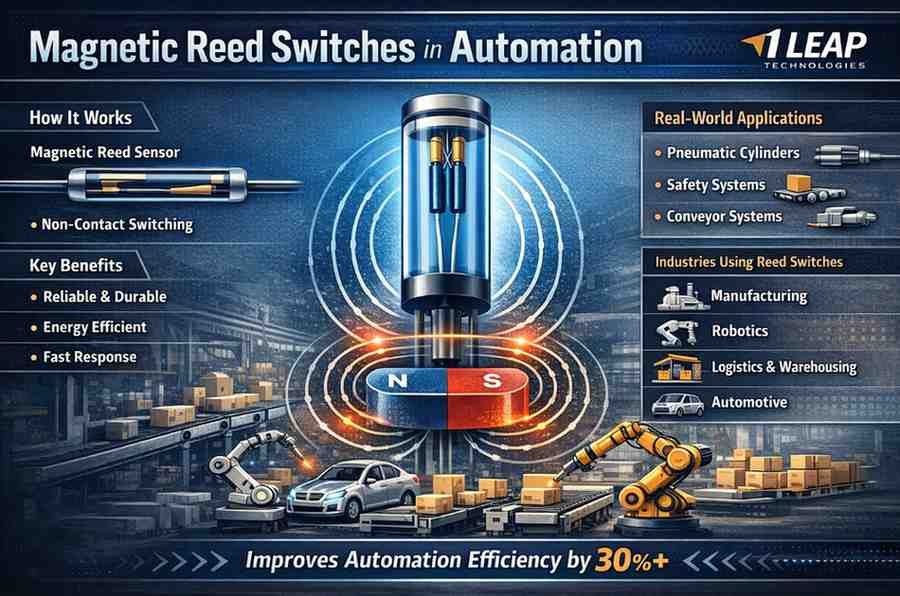
A Reed Switch is a simple but inventive device. It made up of two thin ferromagnetic metal reeds sealed inside a small glass tube filled with an inert gas. When a magnetic field is about brought near the switch, the reeds become magnetized and attract each other, closing the electrical circuit. Once the magnetic field is removed, the reeds separate and the circuit opens again.
This simple mechanism allows the switch to operate without any direct mechanical contact with the moving object, it detects. Because of this, the Reed Switch is considered as a non-contact sensing solution, making it an ideal for automation environments where regular mechanical wear could reduce the lifespan of traditional switches.
When combined with magnets or merge into a magnetic reed sensor, the technology becomes even more flexible. The sensor can detect movement, position, speed, and proximity, all without requiring complicated electronics or continuous power consumption. One of the reasons this technology has remained related for decades is its reliability. A high-quality Reed Switch can perform millions or even billions of switching cycles when used within its specified parameters. This reliability makes it especially valuable in automated systems that run continuously in factories.
Why Automation Systems Depend on Reed Switches
Automation environments require components that can operate with high quality while resist vibration, dust, temperature fluctuations, and long operating hours. Many electronic sensors struggle in these hard industrial conditions, but Reed Switch technology continues to perform unusually well.
One of the huge advantages of a magnetic reed sensor in automation is its simplicity. Far from complex electronic sensors, a Reed Switch does not need regular power or complicated signal processing. This reduces both installation costs and maintenance requirements.
Another important factor is durability. Since the switching mechanism is enclosed inside a hermetically sealed glass capsule, the internal contacts are protected from moisture, dust, and oxidation. This sealed structure majorly increases the lifespan of the component, especially in industrial environments where contamination is common.
Automation engineers also recommended Reed Switches because they are highly energy savings. Many sensing technologies require regular power to operate, but a Reed Switch only reacts when a magnetic field is present. This makes it extremely useful in systems where energy consumption must be minimized. Additionally, magnetic reed sensors provide an especially fast response times. The switching process occurs within milliseconds, allowing automation systems to monitor machine movement or object positioning in real time.
Real-World Uses of Magnetic Reed Sensors in Industrial Automation
Over the world, factories and manufacturing plants depends on Reed Switch technology to control and monitor automated systems. One of the most common applications can be found in pneumatic and hydraulic cylinders used in automated machinery.
In many production lines, pneumatic cylinders move parts, tools, or robotic arms. A magnetic reed sensor attached to the cylinder can detect the position of the piston inside the tube. This allows automation systems to know exactly when a piston has reached a specific point, making sure the accurate and synchronized machine operations.
For example, in automotive manufacturing plants, robots use pneumatic lever to position components during assembly. Reed Switch sensors help detect when the actuator has reached the correct position, making sure an accurate alignment. Without this feedback, automated assembly could become inconsistent and lead to production errors.
Another important application is safety monitoring in industrial machinery. Many factory machines use safety doors or protective guards to protect workers from moving parts. A Reed Switch combined with a magnet can detect whether the door is open or closed. If the door opens while the machine is running, the system can immediately stop operation to prevent accidents.
According to industrial safety reports, automated safety systems that include magnetic reed sensors can majorly reduce workplace injuries. In high-risk environments such as metal fabrication and heavy manufacturing, these sensors act as an additional layer of protection for workers.
Magnetic reed sensors are also hugely used in conveyor systems, which are the backbone of automated production lines. In logistics warehouses and manufacturing plants, conveyors transport products between different stages of production. Reed Switch sensors can detect the presence or movement of objects, helping automation systems track product flow.
A study conducted in automated packaging facilities showed that position sensors, including Reed Switch devices, improved conveyor monitoring accuracy by over 30 percent compared to older mechanical detection systems.
Reed Switches in Robotics and Smart Manufacturing
Modern factories are fastly adopting Industry 4.0 technologies, which involve modern machines, robotics, and interconnected systems. Even in these advanced environments, the Reed Switch continues to play an important role.
In robotic systems, accuracy positioning is important. Robotic arms must move with huge accuracy to assemble components, handle fragile materials, or perform welding operations. Magnetic reed sensors help detect the position of moving robotic parts, providing feedback to the control system.
Because Reed Switches are compact and lightweight, they can be integrated easily into robotic assemblies without affecting performance. Their ability to operate without physical contact makes them especially useful in high-speed robotic environments where mechanical switches would wear out quickly.
Smart manufacturing systems also depends on sensors to monitor equipment conditions and make sure an efficient operations. Magnetic reed sensors can detect an equipment positions, machine states, or access points in automated facilities. This data helps factory managers maintain smooth operations and prevent unexpected downtime.
In large industrial facilities where thousands of sensors operate at the same time, reliability becomes important. Reed Switch technology provides a long operational life and uniform performance, making it a trusted choice for automation engineers.
Automation in Warehousing and Logistics
Automation is no longer limited to manufacturing plants. Modern warehouses and logistics centers are becoming highly automated environments where sensors guide equipment, track goods, and makes sure a smooth operations.
Magnetic reed sensors are commonly used in automated storage systems, robotic picking systems, and warehouse safety mechanisms. For example, automated guided vehicles (AGVs) that move products around warehouses often depends on sensors to detect positions and navigation points.
A Reed Switch combined with a magnetic marker can act as a position detection system for these vehicles. When the vehicle passes a magnetic point on the floor, the sensor activates and signals the control system. This helps the vehicle determine its location within the warehouse.
According to global logistics automation studies, automated warehouses using modern sensor technologies have increased operational efficiency by nearly 40 percent while reducing human error. Reed Switch devices contribute to this improvement by providing accurate and authentic sensing capabilities.
Energy Efficiency and Long-Term Cost Benefits
One of the major concerns for factory owners is operational cost. Automation systems may include thousands of sensors and switches, which means energy consumption and maintenance expenses can collect quickly.
A magnetic reed sensor provides a cost-effective solution because it operates with minimal power requirements. Many Reed Switch devices work passively, meaning they do not require continuous electrical power to detect magnetic fields. This characteristic makes them an ideal solution for battery-powered systems or remote industrial installations where energy efficiency is important.
Additionally, the long lifespan of Reed Switches reduces maintenance costs. Traditional mechanical switches often fail due to friction, corrosion, or repeated physical stress. Since Reed Switch contacts are sealed in glass and operate magnetically, they experience far less wear.
Many high-quality Reed Switch products are capable of performing over one billion switching cycles in low-power applications. This exceptional durability makes sure the reliable performance even in high-frequency automation systems. For factory owners, this translates into lower replacement costs, reduced downtime, and improved productivity.
Accuracy in Hard Industrial Environments
Factories are not always clean or controlled environments. Dust, oil, vibration, and temperature changes can damage sensitive electronic components. However, the hermetically sealed design of a Reed Switch protects the internal contacts from external contaminants.
This makes magnetic reed sensors suitable for hard environments such as:
- Industrial machinery
- Automotive manufacturing plants
- Food processing facilities
- Chemical plants
- Heavy equipment manufacturing
Because the switch contacts are sealed in inert gas, oxidation and contamination are minimized. This design feature majorly increases the reliability of the sensor compared to open-contact switches.
In industries where equipment must operate continuously for long periods, reliable components are important. A single sensor failure can stop an overall production line, causing costly delays. Reed Switch technology helps prevent such disturbance by providing an uniform performance over extended periods.
The Role of Magnetic Reed Sensors in the Future of Automation
Automation continues to develop as industries adopt smarter technologies and connected systems. While new sensing technologies are constantly emerging, the Reed Switch remains relevant due to its simplicity, reliability, and efficiency.
Many modern automation systems combine multiple sensor types to achieve the real performance. In these hybrid systems, magnetic reed sensors often serve as dependable backup or complementary sensing devices.
For example, modern robotics may use optical sensors or electronic proximity sensors for complex tasks, while Reed Switch devices provide simple position confirmation or safety detection. This layered approach increases system reliability and reduces the risk of sensor failure.
As factories continue to move toward fully automated production, small yet reliable components like the Reed Switch will remain an important building blocks of industrial technology.
How 1 LEAP Technologies Supports Industrial Automation
At 1 LEAP Technologies, we specialize in manufacturing high-quality Reed Switch and magnetic reed sensor solutions designed for industrial applications. Our products are made to meet the demanding requirements of automation environments, providing durability, accuracy, and long operational life.
We work closely with automation engineers, equipment manufacturers, and industrial system designers to develop magnetic switching solutions that combined perfectly into modern machines.
From pneumatic cylinder sensing to safety monitoring and robotic positioning, our Reed Switch technology helps industries build smarter, safer, and more efficient automation systems.
Conclusion
In the world of industrial automation, even the smallest components can have a major impact. The Reed Switch is a perfect example of how a simple device can play an important role in complex automated systems.
By enabling reliable non-contact sensing, magnetic reed sensors help machines detect movement, monitor positions, and improve safety over a huge range of industries. Their durability, energy efficiency, and cost-effectiveness make them an ideal choice for factory owners and automation engineers alike.
As automation continues to shape the future of manufacturing and logistics, the importance of reliable sensing technology will only grow. With decades of proven performance and ongoing innovation, Reed Switch technology remains a trusted solution powering the automated world.
Through modern manufacturing and engineering expertise, 1 LEAP Technologies is proud to contribute to this progress by providing the high-quality magnetic reed sensors that support the next generation of industrial automation.