
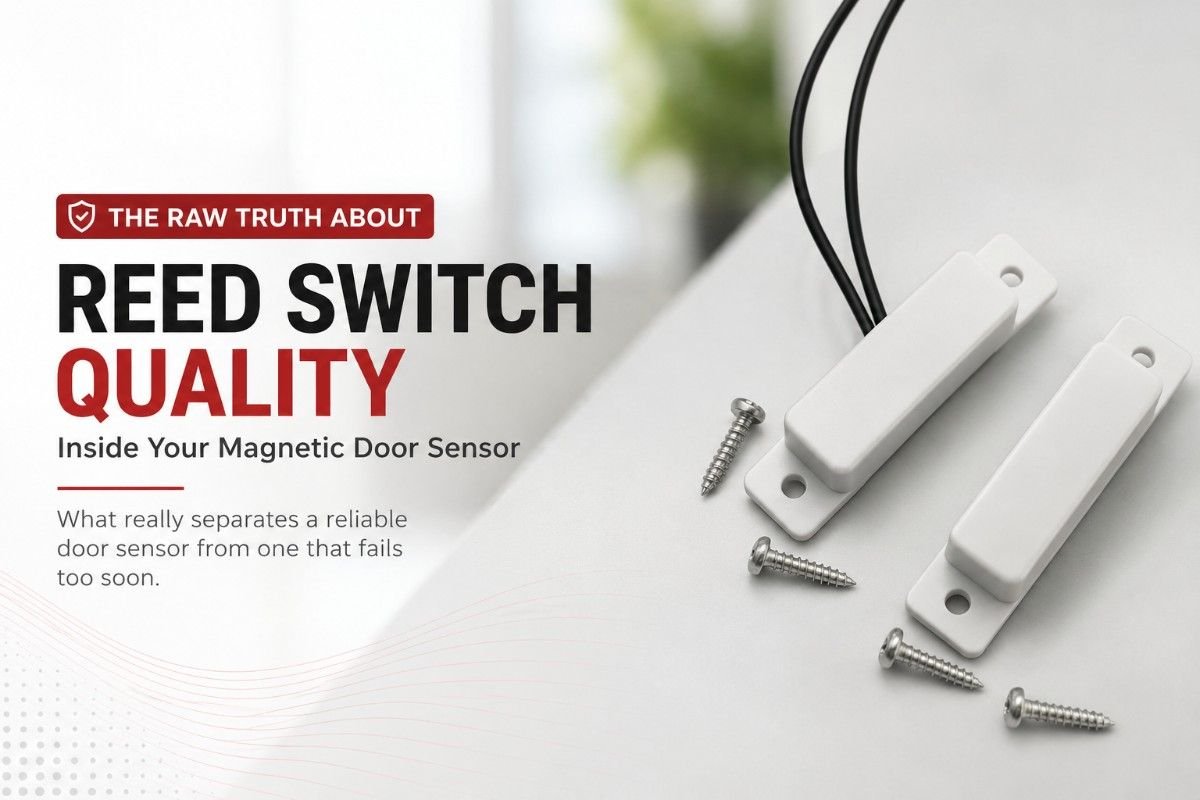
Most door magnetic switch failures happens due to cheap contact plating, thin glass, and sloppy magnet gap. A good reed contact switch runs 5-10 million cycles without float. A bad one switch fails in months. Quality looks inside the magnetic switch, not on the label of switch.
You’ve installed door sensors, and in three months, half of them gives you the false alarms. Or worse than this, they just stop doing their work at all. Sound familiar? Honestly, it happens way more than it should be done, and it’s almost never the wiring issues. It’s what sealed inside that little glass tube.
We made magnetic reed switches every day at 1 LEAP Technologies, so we’ve seen the good, and bad. This article breaks down what actually keeps separates a switch that lasts for a decade from one that dies before the warranty does.
What's Actually Happening Inside a Reed Contact Switch?
A reed contact switch uses two ferromagnetic blades sealed in a glass tube filled with inert gas. A magnet moves close, the blades pull it together and touch after those current flows. Move the magnet away, the blades spring back open.
Here’s the mechanism. Inside every door magnetic switch there is a hermetically sealed glass provided. Two overlapping metal reeds sit a few thousandths of an inch apart, each one plated at the contact point. When a permanent magnet (usually the piece mounted on the door itself) gets close enough, it induces a magnetic field strong enough to pull the reeds together. That’s your closed circuit. Pull the door open, the magnet moves away, the field weakens, and spring in the blades snaps them back apart.
Simple, right? But the details matter a lot here.
First, the glass has to be sealed under nitrogen or a nitrogen-hydrogen mix, sometimes even a hard vacuum for high-voltage applications. Air inside the tube it means oxidation on the contact surface over time, and oxidation means rising contact resistance.
Then there’s the plating. Cheap manufacturers use bare ruthenium or thin gold flash over the blade. Better manufacturers use rhodium or a thicker gold-over-nickel stack, sometimes 3-5 microns thick, specifically because it resists pitting from repeated arcing.
Also, the AT rating (Ampere-Turns) determines exactly how strong a magnetic field a switch needs to trip. A quality reed contact switch holds a tight AT tolerance, usually within ±10%. A low-grade one can swing 20-30% batch to batch, which is exactly why some door magnetic switch installs need the magnet sitting closer on one door than another, even though they’re supposedly the same model.
Plus, contact resistance is the number for which nobody talks about but everybody should. A well-made switch holds contact resistance under 100 mΩ over its rated life. Cheap ones start around there and creep up past 500 mΩ within a year of daily cycling. That creep is what causes intermittent signal drops that drive installers insane.
Reed Switch Quality: High-Grade vs. Low-Grade, Side by Side
The gap between a premium reed contact switch and a cheap one shows up in plating material, cycle life, and sealing method. Check this table before you buy reed switch units in bulk, because the spec sheet rarely tells the whole story of a door magnetic reed switch.
The bottom line is that a door magnetic switch made on the left column of that table costs more but saves you truck rolls, warranty claims, and angry phone calls down the line.
The 3 Main Reasons Reed Switches Fail in the Field
Reed switches mostly fail due to contact welding due to voltage spikes, glass cracking from impact or thermal shock, and gas leakage that lets moisture come into the switch. All three trace get back to cutting corners during manufacturing.
1. Contact Welding from Inductive Loads
This one’s harsh. When a reed switch controls a relay coil or any inductive load without a proper slight, the collapsing magnetic field gives a voltage spike at the moment of contact break. That spike can literally weld the two reeds together. A quality reed contact switch either ships with a made in diode/RC snubber recommendation or gets rated conservatively enough to survive incidental spikes. Cheap switches skip this consideration overall, and installers find out the hard way when a door sensor gets stuck permanently “closed ” to work at industries.
2. Glass Fracture from Thermal or Mechanical Shock
The glass envelope is the weak point, physically speaking. Thin-wall glass (under 0.3mm) cracks from drop impacts during installation or from rapid temperature swings, like a sensor mounted on an exterior loading dock door in winter. Once that seal breaks, the inert gas escapes, moisture gets in, and corrosion starts eating the contact surface within the weeks.
3. Magnetic Gap Drift
Doors sag. Frames shift. Over months of use, the physical gap between the magnet and the door magnetic switch changes, sometimes by just a millimeter or two. On a switch with tight AT tolerance, that drift barely matters. On a switch with loose AT tolerance, that same drift pushes it right out of its trip range, and now you get false “door open” alerts, or worse, no alert at all when the door actually opens.
4. Contamination and Poor Encapsulation
Dust, humidity, and salt air (think coastal warehouses) work their way into badly potted housings. Once moisture reaches the lead wires or the glass-to-metal seal, corrosion climbs up the leads and resistance spikes. Good manufacturers pot the leads in epoxy and use UV-stable housings specifically to block this path.
How Do You Actually Buy Reed Switch Units That Won't Fail on You?
Ask for the cycle-life test data, contact resistance spec in mΩ, and AT rating tolerance before you buy any reed switch products in volume. Real manufacturers hand this over without hesitation.
So you’re sourcing for a project, or maybe restocking for a security integration business. Here’s what to actually check, in order.
- Ask for the cycle count rating, in writing. Anything below 1 million cycles is a red flag for commercial door applications that open dozens of times a day.
- Get the contact resistance number. Not “low resistance.” An actual mΩ figure, tested, with a datasheet.
- Check the AT rating and its tolerance. ±10% is solid. Anything vague like “standard sensitivity” without a number means they probably don’t test batch regularly.
- Confirm the sealing method. Nitrogen-filled or vacuum-sealed glass beats ambient-air sealing every time, especially for outdoor or industrial reed contact switch applications.
- Look at the operating temperature range. A switch rated only -10°C to +85°C won’t survive a rooftop unit door in Phoenix summer or a Minnesota loading dock in January.
- Request certifications. UL listing and RoHS compliance aren’t just checkboxes. They mean somebody independently verified the claims.
- Test a sample batch yourself if volume justifies it. Cycle a handful of units on a bench rig before committing to a 10,000-unit order.
Plus, don’t just trust the price tag as a quality signal. Some suppliers mark up mediocre switches because they know installers won’t crack one open to check. Others sell excellent reed contact switch units at fair prices because their manufacturing process is efficient, not because the quality is cut.
Ask the technical questions above and you’ll know within one email exchange whether you’re dealing with a real manufacturer or a reseller repackaging an unknown stock.
Why This Actually Matters for Factories and Facilities
Safe door magnetic switch sensors protect factory perimeters, track access on high-security doors, and feed data into an automated safety systems. A single false trigger on a production floor can halt a line and cost thousands per hour.
Here’s some real-world context most articles skip. Industrial facility teams depends on door magnetic switch sensors for way more than burglar alarms. On a factory floor, these sensors interlock with machine guards, so a machine physically can’t run with its access panel open. That’s an OSHA-relevant safety function, not a convenience feature. A false negative there, meaning the switch reports “closed” when the door is actually open, can be a genuine injury risk.
In warehousing, facility managers report that a single stuck-open loading dock sensor can trigger unnecessary HVAC losses that add up to real money over a season, especially in temperature-controlled storage. One mid-size cold storage operator we’ve worked with tracked a rough 12% jump in energy costs tied directly to sensors that weren’t reliably reporting door status, before switching to higher cycle-life reed contact switch units.
Also, in access control systems over office buildings and data centers, magnetic reed switches log every door event for compliance and audit trails. A switch drifting out of its AT range doesn’t just annoy people, it creates gaps in a security log that auditors will absolutely flag. So yeah, this “small glass tube” carries more responsibility than it looks like it should.
As a manufacturer, 1 LEAP Technologies builds magnetic reed switches specifically with these industrial and security-grade use cases in mind, because we’ve heard directly from installers and engineers about what goes wrong with the cheaper stuff.
FAQ: Quick Answers on Reed Switch Quality
Q1: How long should a good reed contact switch last?
A quality reed contact switch rated for 5-10 million cycles typically lasts 8-10 years in a standard commercial door application, cycling roughly 20-50 times a day. Industrial or high-traffic doors will hit that cycle count faster.
Q2: What's the difference between a door magnetic switch and a standard reed switch?
A door magnetic switch is a reed switch packaged specifically for door/window sensing, usually with a matched magnet housing and mounting hardware. The reed switch itself is the internal component doing the actual sensing work.
Q3: Can I buy reed switch units in small quantities for testing before a bulk order?
Yes, and you should. Reputable manufacturers, including 1 LEAP Technologies, provide sample quantities so installers and engineers can bench-test cycle life and contact resistance before committing to volume.
Q4: Does contact resistance actually affect real-world performance?
Absolutely. Rising contact resistance causes voltage drop all over the switch, which can trigger false readings on sensitive alarm panels or access control boards, even though the switch is technically still “working.”
Check this out one more time before you place your next order: the spec sheet only tells part of the story. The plating, the seal, the AT tolerance, and the glass thickness are what actually determine whether your door magnetic switch survives real-world use or ends up as a callback ticket.
Ask the right questions, get the real numbers, and you’ll buy reed switch products that actually hold up.