
Understanding Reed Switch Technology in Modern Engineering
A Reed Switch, also known as a Magnetic Switch or reed contact switch, is an electromechanical device that functions through magnetic field interaction with ferromagnetic reeds inside a hermetically sealed glass capsule. Despite its straightforward design, the reed switch is a well-engineered part that can switch quickly, last a long time, and perform reliably even in tough environments. It does not need electrical power to stay active, making it one of the most energy-efficient magnetic sensing technologies available today.
Magnetic reed switches are essential in applications where no standby power, durability, and reliability are more important than continuous field measurement or adjustable sensitivity. The switch is sealed within a glass capsule, protecting it from dust, moisture, corrosion, and conductive contaminants that might interfere with electronic sensors. This protection helps counteract mechanical wear and oxidation, ensuring steady performance over millions of operations.
The basic operating principle relies on the magnetization of the reeds. When they get close to a magnetic field, the reeds attract each other and close the circuit. Once the field is gone, the reeds return to their original open position. This simple yet strong mechanism lets reed switches respond quickly, sometimes ten times faster than miniature mechanical relays, without the contact bounce common in many mechanical switch designs. Engineers often prefer reed switches for applications requiring fast response speeds and simple mechanics
Quick Comparison Overview
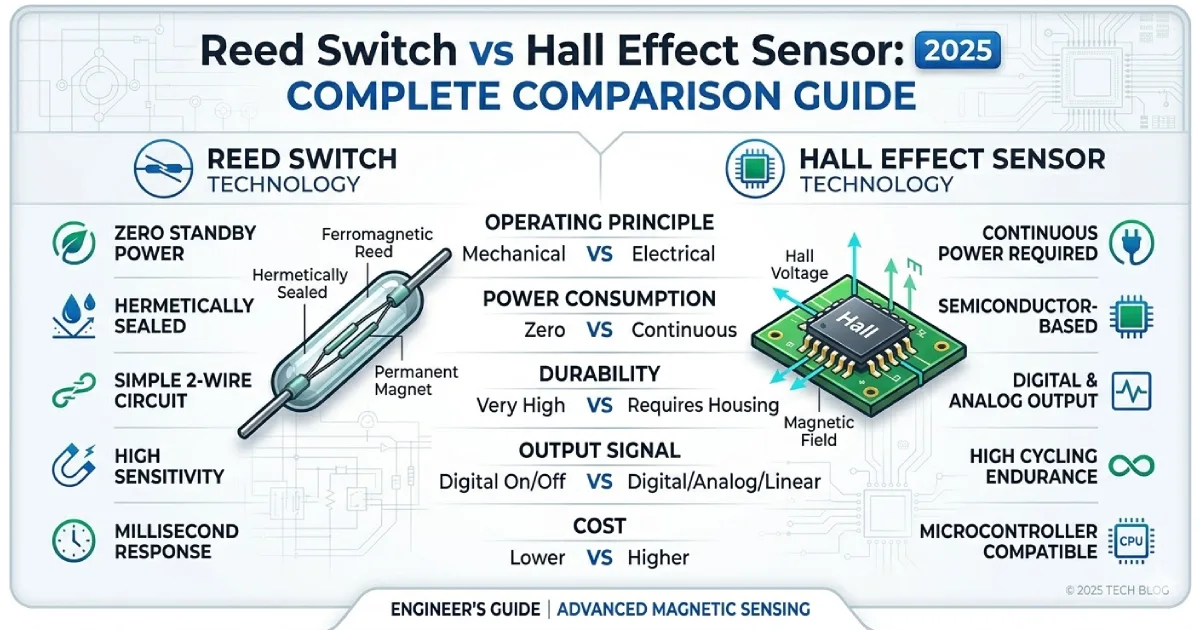
Parameter | Reed Switches | Hall Effect Sensors |
|---|---|---|
Power Consumption | Zero standby power | Continuous power required (3–20 mA) |
Switching Speed | Millisecond response, up to 10× faster than comparable relays | Typically slower due to electronic processing |
Environmental Durability | Hermetically sealed, dust- and waterproof, explosion-safe | Requires protective housing and conditioning circuitry |
Component Cost | Lower component cost | Higher cost due to integrated electronics |
Magnetic Sensitivity | Detects weak magnets at greater distances | Adjustable sensitivity; requires stronger fields for digital switching |
Temperature Effects | Extreme hot or cold changes magnetic properties, affecting switching | Use switches and magnets rated for operating temperatures |
Circuit Complexity | Simple 2-wire connection | Requires power supply, amplifier, and signal processing |
How Reed Switch Technology Continues to Evolve
The development of reed switch technology over the past decade has led to various mounting options, including surface mount, recessed mount, and overhead mount devices, each designed for specific environmental and structural needs. Surface mount versions provide durability in compact mechanical setups. Recessed mount models fit nicely into architectural and industrial systems where minimizing visual impact is crucial. Overhead mount designs work well in high-reach industrial settings, allowing technicians to perform maintenance without disassembling equipment.
Reed switches have also gained importance in modern engineering trends like ultra-low-power IoT devices, autonomous machinery, and smart infrastructure sensing. Their zero power draw when idle allows battery-powered systems to last for years, making them perfect for remote or hard-to-reach installations. Their immunity to electromagnetic interference (EMI) supports reliable performance in electric vehicles, high-frequency machines, and power-dense industrial settings.
How Reed Switches Work
- A magnetic field from a permanent magnet or electromagnet induces magnetization in the contacts.
- Contacts close within milliseconds, completing the circuit.
- Spring-forced contact separation upon field removal reopens the circuit.
Hall Effect Sensor Technology in Contemporary Designs
Hall Effect Sensors differ from reed contact switches because they depend on semiconductor physics rather than mechanical movement. A Hall sensor measures the voltage created across a thin semiconductor element when a magnetic field interacts with an electric current flowing through it. This Hall voltage is amplified and processed by integrated electronics to produce a usable digital or analog output.
Hall sensors have become standard in modern digital systems due to their compatibility with microcontrollers, continuous measurement ability, and very high cycling endurance. Unlike reed switches, which only detect the presence or absence of a magnetic field, Hall sensors can provide proportional analog outputs, enabling them to measure field strength, position, and even direction. This ability has made Hall sensors necessary in advanced robotics, linear position measurement systems, brushless DC motor control, and adaptive control systems in automotive applications.
However, the benefits of Hall sensors come with significant costs. They need continuous power—typically 3 to 20 mA—to operate, which adds up in battery-powered products. Their semiconductor structure also requires extra protection from moisture, dust, and corrosive environments, making them less rugged than hermetically sealed reed switches unless additional housings or potting materials are used.
Operation Principles
- Digital Hall sensors change state when a certain magnetic field strength is reached, providing a binary signal suitable for on/off detection
- Analog Hall sensors produce a continuous voltage that corresponds to the magnetic field's strength, making them ideal for variable-distance sensing and closed-loop control.
- Linear Hall sensors offer detailed field strength measurement and polarity detection, enhancing advanced position sensing
In contrast, reed switches work when a magnetic field magnetizes their ferromagnetic contacts, pulling the reeds together to close the circuit. When the field is removed, the reeds demagnetize and reopen. Their operation does not require continuous current or active circuitry, making them particularly beneficial for low-power applications.
Performance and Behavior in Real-World Conditions
In today’s engineering landscape, performance is about more than just raw specifications. It includes resistance to the environment, compatibility with power budgets, mechanical integration needs, and maintenance over time. Reed switches offer complete zero-power standby capability, allowing them to stay in sensing mode indefinitely without using any energy. This advantage directly affects long-term operating costs, especially in battery-powered systems where every milliamp saved extends service life.
On the other hand, Hall sensors use power continuously, regardless of their state. This continuous energy draw can be a major drawback in IoT devices, remote sensors, or field equipment that need to run for long periods without human intervention.
Environmental durability also sets the two technologies apart. Reed switches, housed in hermetically sealed glass, resist environmental extremes like no other. They can be submerged, exposed to corrosive vapors, placed in explosive atmospheres, or used in devices that experience intense vibrations. Hall sensors need careful mechanical housing to achieve similar protection. Even when shielded, their onboard electronics are more susceptible to temperature changes, moisture, and chemical exposure.
In terms of magnetic sensitivity, reed switches often detect weaker magnetic fields better, resulting in greater sensing distances with smaller magnets. This becomes critical in security systems, industrial automation, and precision mechanical assemblies where physical contact must be avoided. Hall sensors can adjust sensitivity, but these adjustments rely on electronic amplification and threshold control, usually requiring stronger magnetic fields for digital switching.
Application Analysis for 2025 Engineering Requirements
Security and access control systems continue to depend heavily on magnetic reed switches because of their zero standby power, silent operation, and potential for hidden installation. Door and window sensors in both residential and commercial buildings benefit from their simplicity and reliability, as well as their long maintenance-free operation. Concealed magnets and recessed mount reed switches form tamper-resistant mechanisms that remain unaffected by dirt, moisture, and temperature changes.
In industrial automation, reed switches are widely used in conveyor systems, mechanical limit detection, and safety interlocks. Overhead mount designs allow engineers to place these sensors in easily accessible parts of complex machines, ensuring compliance with safety regulations and simplifying service. Their resistance to contaminants makes them perfect for environments filled with particulates, oils, or moisture where electronic sensors may fail early
Automotive systems frequently use reed switches for brake, clutch, and fluid-level sensing due to their toughness under constant vibration and temperature fluctuations. Many automotive safety-critical systems need components that can work through extreme temperature changes from deep cold to intense engine heat, and reed switches have demonstrated reliable performance under these conditions for decades.
Marine and aerospace applications require parts that resist corrosion, pressure, moisture, and explosive surroundings. Reed switches shine in these conditions, functioning reliably within sealed navigation modules, underwater instruments, aircraft landing gear sensors, and missile guidance systems. Their hermetic design reduces sparking risks in fuel-rich or oxygen-sensitive environments, where even a small electrical arc can lead to serious hazards.
Hall Effect sensors excel in systems that need continuous magnetic field measurement and digital integration. This includes brushless motor controllers, automotive throttle systems, power steering modules, and robotics requiring precise position feedback. Analog Hall sensors allow engineers to create closed-loop systems where magnetic field changes directly affect real-time adjustments in motion, alignment, torque, or distance
Cost, Integration, and Total Ownership Considerations
When considering total ownership costs, reed switches show significant advantages for binary sensing tasks. They are cheaper to produce, require only simple two-wire installation, and their zero power consumption lowers lifetime energy costs. They need no calibration, generate minimal heat, and last a very long time with proper installation.
Hall effect sensors, while pricier, justify their cost in applications needing continuous analog measurement, specific switching thresholds, or integration into digital systems. Their ease of mounting on printed circuit boards, ability to interface directly with microprocessors, and electronic adjustability provide capabilities that mechanical reed switches cannot match.
However, engineers must also think about maintenance. Reed switches require little upkeep, while Hall sensors may need recalibration based on environmental changes, temperature effects, or aging semiconductor materials. For battery-powered devices, the constant power draw of Hall sensors adds ongoing operational costs.
Choosing the Optimal Sensor for Your 2025 Project
A clear understanding of engineering priorities helps determine the best choice. Reed switches offer attractive benefits in applications where energy efficiency, ruggedness, low cost, mechanical simplicity, and long-term reliability are important. Hall Effect sensors provide essential features in systems needing continuous measurement, fast electronic interfacing, programmable behavior, or multi-threshold switching.
Analog Sensing & Control
When continuous measurement of magnetic field strength is required—such as proximity sensing with varying distance—analog Hall sensors provide proportional output with adjustable thresholds. Their immunity to contact bounce enhances reliability in high-cycle applications.
Total Cost of Ownership
Cost Factor | Reed Switches | Hall Effect Sensors |
|---|---|---|
Component Cost | Lower, standalone switch | Higher, includes electronics |
Integration | Simple 2-wire installation | Complex power and signal routing |
Energy Costs | Zero when idle | Continuous draw impacts battery life |
Maintenance | Long lifespan, minimal upkeep | Potential recalibration and failure |
Reed switches offer lower upfront and operational costs for on/off sensing, while Hall sensors justify their higher cost in applications demanding analog output or precise switching thresholds.
Decision Criteria
Choose Reed Switches when you need:
- Zero power when idle
- Fast, reliable on/off switching
- Hermetic sealing for harsh environments
- Simple mechanical integration (door/window, industrial assemblies)
- High sensitivity to weak magnets
Choose Hall Effect Sensors when you require:
- Analog field strength measurement
- Multiple switching points from one sensor
- Electronic hysteresis control
- Integration into digital control systems
Conclusion
As engineering systems advance in 2025, both reed switches and Hall Effect sensors remain key components in magnetic sensing applications. Magnetic reed switches, with their hermetic sealing, quick actuation, and zero-power operation, are essential for binary sensing in demanding environments. Their longevity, simplicity, and cost-effectiveness make them ideal for security systems, industrial machinery, automotive parts, marine devices, aerospace instruments, and many IoT applications.
Hall Effect sensors enhance these capabilities with programmable behavior, accurate analog output, and complex digital interfacing that support modern automated systems, advanced robotics, and smart control architectures. Engineers need to carefully weigh the trade-offs, considering power consumption, environmental exposure, required precision, installation limitations, and long-term operating costs.
By understanding the key differences between Reed Switch, Magnetic Switch, and Hall effect technologies, designers can confidently select the best component, ensuring that every system—whether industrial, automotive, aerospace, or consumer-focused—achieves improved durability, reliability, and performance throughout its entire operational life.