
Smart Sensors for Pharmaceutical Industry: Boosting Efficiency, Compliance, and Sustainability
The Pharmaceuticals sector is characterised by stringent governmental regulations, environmental norms, and a pressing need for optimizing process efficiency. Be it raw material receipt, production of sterile drugs, packaging, quality testing, or Refrigerated transport, each and every operation requires high standards of quality, traceability, and standardization. It becomes clear that even a minute opening within these two functions will generate multiple instances of Non-Compliance, Deterioration, and Unoperational Effectiveness.
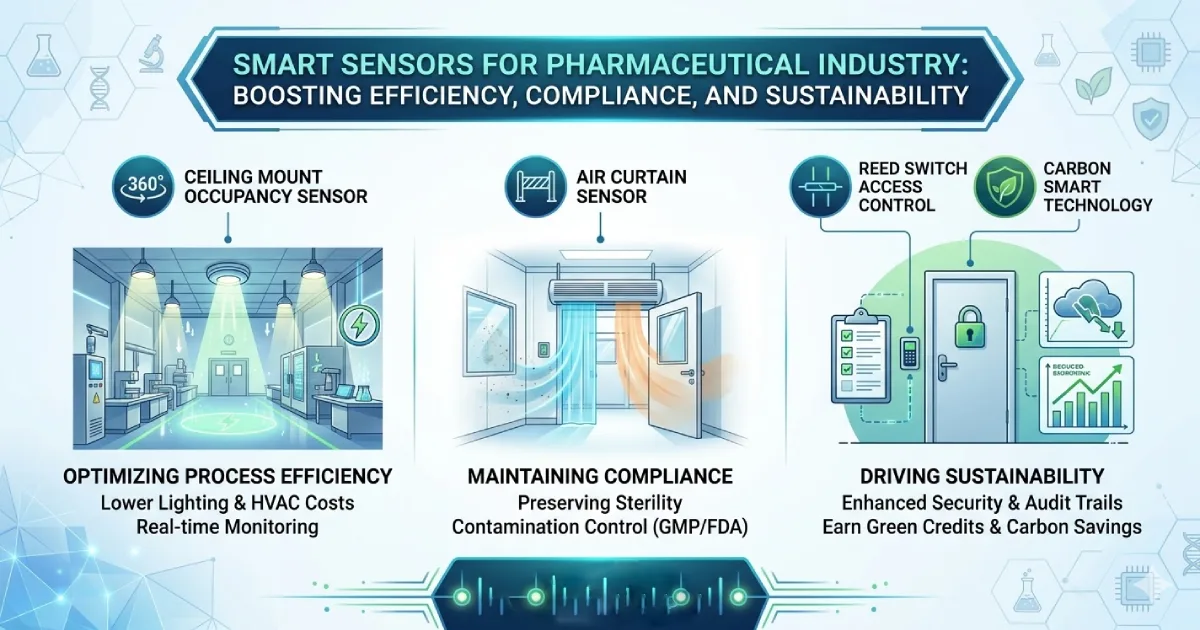
To tackle these emerging challenges, there is an enormous adoption of Smart Sensors on an enormous scale at latest pharmacy labs. At 1 LEAP Technologies, we have created a series of next-gen Smart Sensor Solutions exclusively tailored and designed for the pharma domain. We have products like our Lead Smart Sensor product – Ceiling Mount Occupancy Sensor (1L-PS041), Magnetic Reed Switch, and Air Curtain Sensor designed with an intention to enhance energy efficiency, stability, and security.
In a world trending towards making sustainability and carbon reduction compulsory across various industries, our sensor solutions also contribute towards global decarbonization efforts with its CarbonSmart Sensor Technology and Green Credits and Carbon Savings Advisory. It empowers the pharmaceutical industry to not only optimize but also cut carbon emissions and receive Carbon Credits , thus providing additional value to their sustainability venture. Prior to exploring more about these sensors, it is important to highlight why there is a growing importance of smart sensors within the pharmaceutical sector.
Why Smart Sensors Are Important in Pharmaceutical Industry
- Maintaining Sterility and Clean Room Conditions: Sensors assist in controlling and preventing contamination risks.
- Improved Energy Efficiency: Light and environment responses will be automated. Energy will not be wasted
- Managing GMP, FDA, and CDSCO Compliance: Sensors assist in ensuring records, logs related to access, environmental records, and number audits.
- Enhancing Access Control: Surveillance of high-value and sensitive zones, which prevents unauthorised access.
- Participating in Sustainability Projects: Smart sensors reduce energy consumption and make it easier for facilities to obtain Green Credits and Carbon Credits
- Improving Air Handling and Clean Room Airflow: Reducing heating, ventilation, and air conditioning system workload.
- Reducing Carbon Footprint: CarbonSmart Sensor Technology enables energy-efficient operations that drive measurable CO₂ savings.
- Temperature Stability: Sensors help eliminate temperature variability driven by human influencing factors, which becomes an area of importance within cold chain scenarios
- Developing aDigitally Intelligent and Audit-Ready Facility Because monitoring goes on 24/7, there will be real-time and historical data regarding compliance and internal audits
Use of Ceiling Mount Occupancy Sensor (1L-PS041) at Pharmaceutical Environments
Pharmaceutical production facilities operate for 24 hours a day with very large and well-lit rooms and strict control on heating, ventilation, and air conditioning systems. Clean room facilities, research and development labs, storage sections, and production corridors have constant illumination and temperature requirements based on regulatory standards. But in most pharmaceutical facilities, these sections remain unoccupied for prolonged periods with considerably excessive electrical consumption and an added heating load on air conditioning systems.
The 1L-PS041 Ceiling Mount Occupancy Sensor is created to tackle this issue. It is a 360° motion sensor with dual-range detection that detects people and turns on lights only when necessary. As soon as the area is no longer occupied, it will turn off the lights. Hence, it decreases direct illumination consumption and also the indirect consumption associated with air conditioning.
What makes this sensor futuristic-ready is that it combines Carbon Smart Sensor Technology, which not only manages energy consumption but also monitors energy savings as well as monitors insights on possible carbon savings. Those facilities that have implemented this automation will be capable of greatly reducing operational expenses while at the same time putting themselves forward to qualify for Green Credits within various sustainability initiatives.
For the drug companies seeking to achieve green manufacturing and reduce carbon footprints and align with global standards on the environmental aspect, occupancy sensors make a tangible difference. The facilities experience double-digit savings as a result of reduced heating due to lighting. There are no changes brought about by occupancy sensors on water consumption.
A third and very significant benefit will be achieved with compliance. Automated lighting systems will reduce contact with manually operated switches. These switches are frequently touched together in an infertile area. Reduced contact will translate to fewer contamination sites and will improve cleanroom compliance. In addition to energy savings, the role that the Occupancy Sensor plays in creating intelligent and more eco-friendly pharmacy settings will be deliberate.
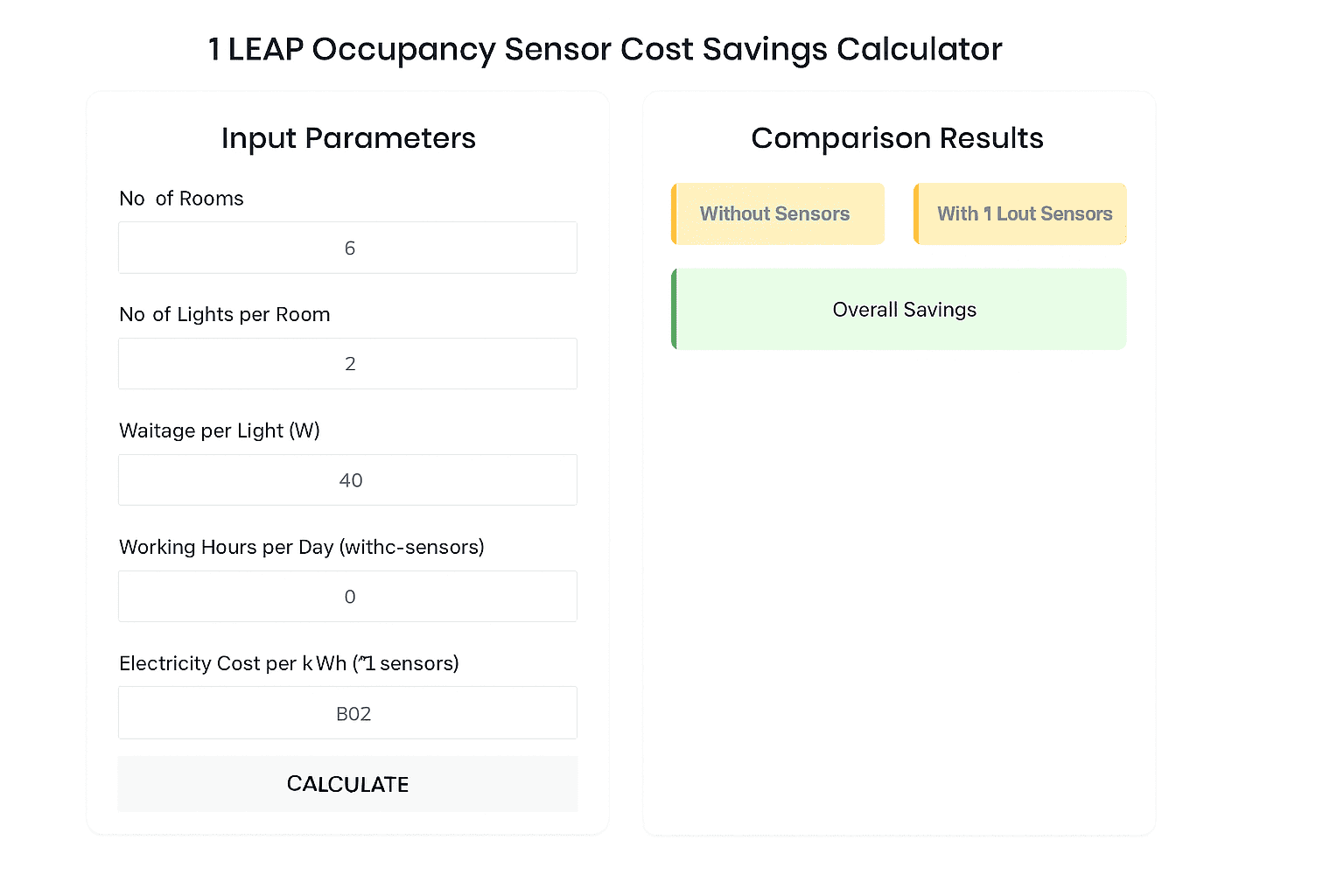
The Alleged Savings and Benefits for Sustainability to help with energy audit and ROI planning decisions, 1 LEAP Technologies offers you an Occupancy Sensor Cost Savings Calculator. It helps analyze:
- An Annual electricity savings
- The Reduction in HVAC load
- Total amount of carbon saved in kg/tons
- Potential value of Green Credits
- Payback period and ROI
Air Curtain Sensor: Preserving Sterility and Ensuring Perfect-Controlled Conditions
It becomes necessary to maintain a clean and temperature-controlled area in pharmacy production. Region variables due to airborne particles, changes in humidity, and changes in pressure difference might affect an entire unit of drug products. It becomes necessary why air curtains are greatly preferred at entrance points, but manually controlling air curtains is ineffective.
The Air Curtain Sensor is an automated system that activates the air curtain as soon as a door is opened, generating a high-speed barrier that keeps dust, bacteria, and warm and unfiltered air out. Its functionality ensures that there are no inconsistencies in sterility procedures and contamination that might have led to production holdups and product rejection.
In a cold chain setting, the sensor functions as an integral component. Large numbers of door openings within vaccine and biologic storage rooms result in warm air entry, making compressors work harder. The result is an increase in energy consumption and inefficiencies. The Air Curtain Sensor presents an end to this challenge as it maintains an air barrier effectively while operating a door.
The benefits brought about by these improvements include considerable energy savings and reduced carbon emissions, which can be realized via 1 LEAP’s CarbonSmart Sensor Technology. These advancements will improve your chances of receiving Carbon Credits and will also be useful for your internal ESG strategy and third-party sustainability audits. By ensuring aseptic and temperature stable conditions, it becomes an integral part of the integrity and environmental responsibilities within pharmaceutical production. Green Credits, Carbon Credits, and CarbonSmart Sensor Technology A Full-Fledged Framework for Sustainability
Pharmaceutical brands around the world have been compelled to enhance energy consumption, mitigate carbon emissions, and adhere to environmental norms. Going green in manufacturing is no longer an option but a preferred action. The role of sensors in the creation of eco-efficient facilities cannot be overlooked.
1 LEAP Technologies fosters this ingenuity with a comprehensive CarbonSmart Sensor Technology platform, engineered to monitor, evaluate, and optimize energy and carbon performance. Along with our Green Credits & Carbon Savings Advisory service, Pharmaceutical businesses can benefit from data-driven insights on sustainability.
Smart sensors benefit the pharma industry in several ways
- Lower usage of electricity with automated control
- Reduce compressor loads in cold storage rooms
- Reducing HVAC energy consumption in clean room environments
- Lower emissions related to heating, cooling, and lighting
- Stable environments that prevent product waste
Savings achieved below can be quantified and linked to existing credit procedures for receipt of Carbon Credits.
Through incorporating smart sensors, drug manufacturers prove dedication to:
- ESG (Environmental, Social, Governance
- Requirements on Renewable Energy and Carbon Emissions
- National and international frameworks on decarbonization
- Sustainable and compliant manufacturing processes
It enables businesses to enhance their eco-reputation, prepare for compliance, and possibly capitalize on their carbon savings. Within India’s increasingly thriving pharmaceutical sector, several plants have made impressive advancements using 1 LEAP’s intelligent sensors.
Success Stories from the Pharmaceutical Sector
Hyderabad-Based Pharma Plant
The challenge they had at this facility was very high illumination costs with respect to the large clean room corridors. The energy consumption at this facility decreased by 20% within 90 days after installing the 1L-PS041 Occupation Sensors. This acted as a contribution to their sustainability report.
Bangalore Biotech Research Facility
The issue with which they were dealing at Arizona State University was related to safeguarding research and intellectual property. Installation of magnetic reed switch access control systems ensured restricted access to all key research labs. Within a short period, there was a 40% reduction in attempts at unsupervised entry.
Pune Vaccine Manufacturer
Cold storage inefficiencies were an area of concern with regards to product stability because there were consistent temperature fluctuations. Air Curtain Sensors implemented at the facility ensured optimum temperature control, suppressed compressor workload on air conditioning systems, and ensured optimal environmental stability. Moreover, it promoted sustainability goals as it saved energy
Benefits of Using Smart Sensors in Pharmaceutical Facilities
Here’s how these smart devices impact pharma operations:
Benefit | How It Helps |
|---|---|
Energy Efficiency | Motion and air curtain sensors reduce unnecessary power usage. |
Process Automation | Reduces manual tasks and improves workflow consistency. |
Regulatory Compliance | Helps meet FDA, GMP, and CDSCO access and documentation norms. |
Enhanced Security | Tracks and restricts access to sensitive assets and rooms. |
Environmental Control | Maintains cleanroom sterility and cold chain temperature integrity. |
Reed switches offer lower upfront and operational costs for on/off sensing, while Hall sensors justify their higher cost in applications demanding analog output or precise switching thresholds.
FAQ – Magnetic Reed Switch Issues
Smart sensors help automate lighting, secure access, and preserve cleanroom or cold chain environments—all while improving energy efficiency.
Yes. All 1 LEAP sensors integrate smoothly with standard BMS, EMS, and security systems used in pharma setups.
Absolutely. Our sensors support compliance with Good Manufacturing Practices (GMP), FDA regulations, and CDSCO access control standards.
Applications where the magnet approaches directly toward the switch (“face to face”) are less likely to encounter dead zones.
A sensor specialist or supplier can guide you in selecting and installing the right reed switch for your project.
Conclusion: A Smarter, Greener, and Compliant Future for Pharmaceuticals
Smart sensors are the future of operations within the pharmacy industry. Smart sensors encompass automation, compliance, and environmental preservation. Using 1 LEAP Technologies, a pharmacy will have more than an operational solution but will also be capable of improving its environmental impact with CarbonSmart Sensor Technology and Green Credits & Carbon Savings Advisory.
Ranging from ensuring clean environments and securing high-value assets to optimizing energy consumption and lowering carbon footprints, intelligent sensors make it possible for pharma manufacturers to operate with confidence and intelligence