
Reed Switch Dead Zone: What It Is and Magnetic Switch How to Minimize It
Reed switches are commonly used in automation, security systems, industrial equipment, and many consumer products. They are simple but reliable magnetic components that help devices detect motion, proximity, or position without physical contact. However, users often face a situation where the switch does not activate, even when the magnet seems to be close. This issue is known as the Reed Switch Dead Zone, which is often mistaken for a defect. In reality, it occurs due to the natural behavior of magnetic physics.
This article explains the dead zone in detail and discusses why it happens, how magnetic fields behave around a reed switch, and what you can do to reduce its impact. Key terms like Magnetic Switch, Magnetic reed switches, Magnetic Reed Sensor, and reed contact switch are incorporated in a natural way
What Is a Reed Switch?
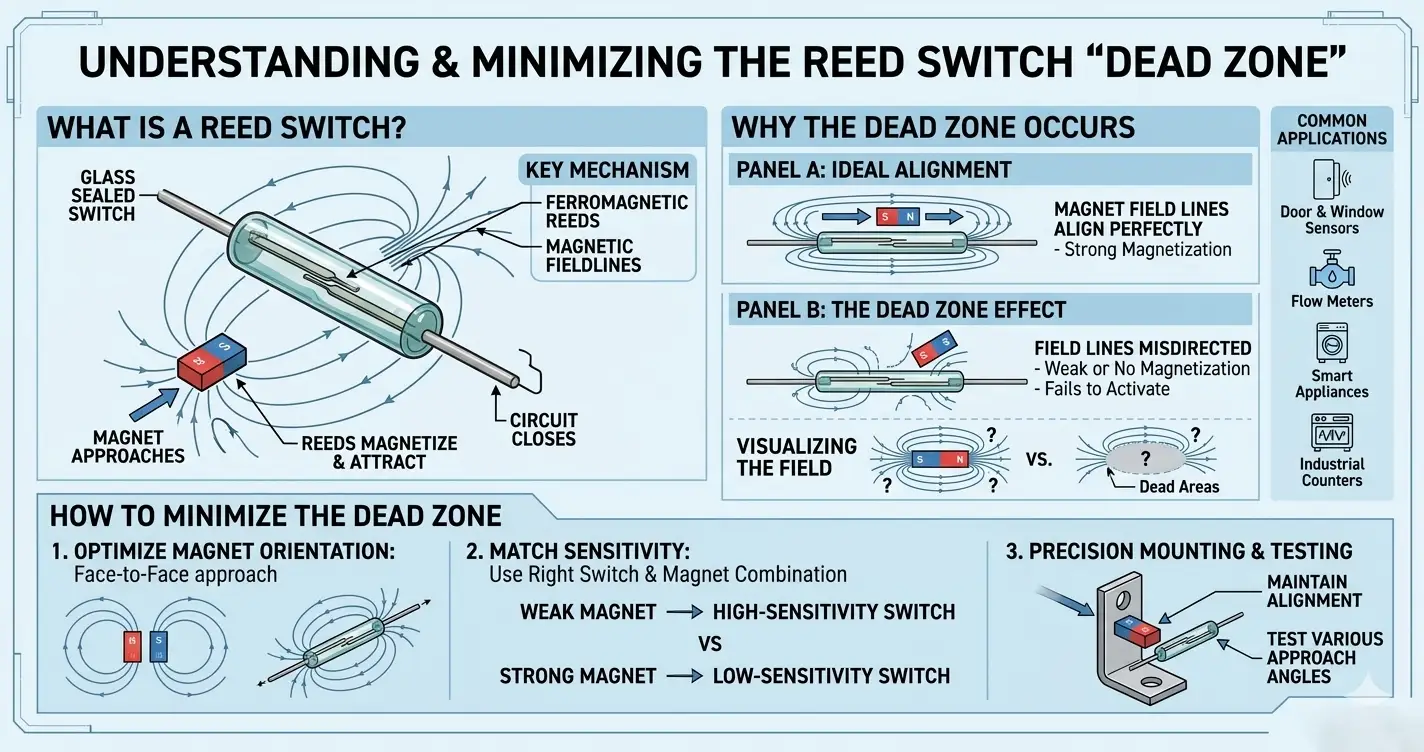
A reed switch is a small electrical device made up of two metal reeds sealed inside a glass capsule. These reeds consist of ferromagnetic material, which responds to a magnetic field. When a magnet approaches the switch, the reeds become magnetized, attract each other, and close the circuit. Because the switch relies on magnetism instead of mechanical movement, it is extremely durable and long-lasting.
Reed switches are one of the simplest forms of Magnetic Switch, yet they are crucial in many systems. You often find them in door sensors, water flow meters, industrial counters, medical devices, smart appliances, and various DIY electronics projects. Their passive nature, zero power consumption, and high reliability make them a popular choice, even when more complex sensors are available
Where Reed Switches Are Commonly Used
Reed switches are found in many industries. In home security systems, they are placed inside door and window sensors to detect if an entry point is open or closed. In automation systems, they help with detecting position, motion, or rotation. In household appliances like washing machines, blenders, and refrigerators, a reed contact switch often controls safety mechanisms and power shut-off functions. Bicycles, treadmills, and vehicles use Magnetic Reed Sensors to track speed and movement. Their versatility explains why many engineers favor magnetic reed switches when designing low-power or sturdy devices.
Understanding the Reed Switch Dead Zone
The Reed Switch Dead Zone is the small area around the reed switch where the magnet may be very close but fails to activate the switch. Users sometimes view this as inconsistency or malfunction, but it is entirely expected. The dead zone is not a defect, but a result of how magnetic fields behave.
Think of a flashlight pointed at a wall. If you move the flashlight at certain angles, parts of the light may dim or disappear, even though the light source remains strong. Similarly, the magnetic field around a magnet has areas where its direction does not align well enough to close the reeds. The switch will only activate when the magnetic field lines reach the reeds correctly and with enough strength.
Why Does the Dead Zone Occur?
The dead zone mainly arises from how magnetic fields interact with the ferromagnetic reeds. A reed switch is most responsive when the magnetic field approaches directly along its length. This alignment properly magnetizes the reeds, causing them to attract one another.
However, when a magnet moves parallel to the switch or approaches from the side, the magnetic field lines may not align with the reeds. Even a small distance can make the magnetic field too weak or misdirected to close the contacts. This results in the dead zone.
Another factor is the shape and strength of the magnet. A small or weak magnet may only activate the switch in specific positions. Even strong magnets, like neodymium, have magnetic fields that change based on their orientation. If the poles of the magnet are not aligned properly with the switch, activation may not occur.
Reed switches also vary in magnetic sensitivity. A low-sensitivity switch needs a stronger field to activate, while a high-sensitivity switch activates more easily. Choosing the wrong sensitivity level for your magnet can enhance the dead zone effect. This is why engineers carefully consider the balance between magnet strength and reed sensitivity
Is the Reed Switch Dead Zone a Defect?
The dead zone is not a defect at all. All reed switches, whether they are basic consumer parts or high-precision industrial components, show this behavior. This effect is based on magnetic physics, and no manufacturing method can completely eliminate it. Even the most advanced Magnetic Reed Sensor assemblies from major manufacturers must adhere to the same physical principles.
Understanding this helps avoid unnecessary troubleshooting. Instead of thinking the switch is broken, it’s better to assess the orientation and direction of the magnetic field.
How Magnet Orientation Affects Activation
In many cases, the orientation of the magnet matters more than the distance. A magnet generates a three-dimensional field, and the reed switch only responds when the field lines line up correctly. For instance, bringing a magnet straight toward the tip of the reed switch generally creates strong magnetization. But moving the magnet sideways—even at a similar distance—can place it in the dead zone.
Slightly rotating the magnet can significantly improve activation. This is especially true for magnets that are axially or diametrically magnetized. Knowing where the magnet’s poles are helps you position it to minimize the dead zone.
How to Reduce the Reed Switch Dead Zone
While you cannot completely eliminate the dead zone, you can greatly reduce it with smart design choices. One of the most important steps is to position the magnet face-to-face with the switch, rather than sliding it along the length. This direct approach ensures strong magnetic alignment and makes activation more reliable
Another key factor is choosing a reed switch with the appropriate sensitivity rating for your application. A high-sensitivity reed contact switch only requires a weak magnetic field, reducing the chances of dead-zone problems. Pairing such a switch with a suitable magnet leads to a much more stable and predictable system.
Testing is also crucial. Before finalizing your design, try different orientations, distances, and angles. Many issues disappear once you identify the ideal placement. In industrial systems where vibration or movement might slightly shift the magnet, engineers often use precise mounting brackets or housings to maintain alignment. This stops the magnet from unintentionally moving into the dead zone during operation
Why Reed Switches Are Still Preferred in Modern Designs
Even with the presence of dead zones, reed switches continue to be very popular for several reasons. They do not need power to work, making them ideal for battery-operated or energy-efficient devices. They are highly resistant to dust, moisture, and electrical noise, making them suitable for outdoor and industrial settings. Their long lifespan ensures reliability in applications where electronic sensors might wear out or fail over time.
A Magnetic Switch based on reed contact design is also more affordable than many digital sensors, making it suitable for mass production. Whether used in alarm systems, medical equipment, smart devices, or industrial machinery, reed switches provide simplicity, durability, and consistency.
FAQ – Magnetic Reed Switch Issues
Dead zones occur when the magnet’s field is not strong or properly aligned to trigger the reeds. This usually happens due to sideways movement of the magnet.
No. However, you can minimize them by using stronger magnets, more sensitive switches, and better positioning.
No—the dead zone is normal and expected in all reed switches.
Applications where the magnet approaches directly toward the switch (“face to face”) are less likely to encounter dead zones.
A sensor specialist or supplier can guide you in selecting and installing the right reed switch for your project.
Conclusion
The Reed Switch Dead Zone is a natural phenomenon that happens due to magnetic field alignment and sensitivity. It is not an indication of a faulty switch or a poor-quality magnet. Once you grasp how magnets and reed switches interact, designing reliable and consistent systems becomes much easier. By adjusting the angle, selecting the right sensitivity level, and choosing an appropriate magnet, you can significantly reduce dead-zone effects
At 1 LEAP Technologies, we help customers choose the best reed switches, magnets, and sensor setups for their specific projects. Whether you’re working on security systems, automation equipment, industrial sensing, or custom electronics, our team is ready to help you achieve smoother and more dependable switching performance