
The Difference Between NO and NC Reed Switches
Reed switches are the most important components used in today’s security systems, automation solutions, smart devices, and industrial equipment. Their simple contactless working mechanism, long durability, and ability to operate reliably in hard environments make them a favoured choice for engineers and product designers worldwide. One of the most important concepts in using reed switches effectively is understanding the difference between the two main types: Normally Open (NO) and Normally Closed (NC) reed switches. Although they may look identical from the outside, their internal functioning and electrical behavior vary majorly. This article explores both types in detail, describing how they work, how they are constructed, where they are used, and how to select the right switch for your application. Insights are also inspired by creative companies such as 1 LEAP Technologies, known for producing high-quality reed switches and magnetic sensors.
What Is a Reed Switch?
A reed switch is a magnetically operated electromechanical switching device enclosed inside a hermetically sealed glass capsule. It contains two ferromagnetic metal reeds placed very close to each other but not touching. When a magnetic field approaches the switch, these reeds either come together or move apart depending on the switch configuration. This switching action happens without requiring any physical contact, pressure, or mechanical movement from the user, which is why reed switches are extremely reliable and durable. The sealed construction makes sure that the internal components remain protected from dust, moisture, chemicals, oxidation, and environmental contamination, allowing the switch to function efficiently for millions of operations. Their simplicity does not limit their capability; instead, it makes them highly versatile for countless applications ranging from home security to industrial automation.
The reeds inside the glass tube are made of a special nickel-iron alloy with high magnetic sensitivity. These reeds are plated with metals like rhodium or ruthenium, which reduce contact resistance and improve switching performance. The glass envelope is specially designed to maintain the correct gap distance, minimize air contamination, and withstand variations in temperature and humidity. When a magnet is brought near the reed switch, magnetic flux lines pass through the ferromagnetic material, causing the reeds to either attract or repel based on the type of magnetic reed switch. Since the switching happens without sparking or friction, reed switches also become suitable for hazardous environments where even a small spark could be dangerous.
Working Principles Of Reed Switches
The internal construction of a reed switch is extremely simple yet technically sophisticated. The primary components include the glass capsule, the ferromagnetic reeds, the overlapping contact points, and the extended lead wires. The air gap between the reeds plays an important role in determining the sensitivity and activation distance of the switch. This gap is carefully engineered so that it reacts accurately to magnetic fields while preventing false triggering. The reeds themselves are thin, flexible metal strips that are designed to slightly bend under magnetic influence. Even the type of magnet used—whether neodymium, ceramic, or ferrite—can affect the distance and force required to operate the switch.
When the switch is in its default state, the reeds remain in either contact or non-contact position depending on whether the switch is NO or NC. As soon as the magnetic field approaches, the reeds respond quickly because their ferromagnetic nature allows them to become temporarily magnetized. This magnetic force either pulls the reeds together or pushes them apart. The moment the magnet moves away, the reeds return to their original position. This simple magnetic reaction forms the core working principle of both NO and NC reed switches. Their contactless mechanism makes sure that there is no wear and tear on the switching elements, resulting in long-term operational reliability.
Normally Open (NO) Reed Switch
Definition
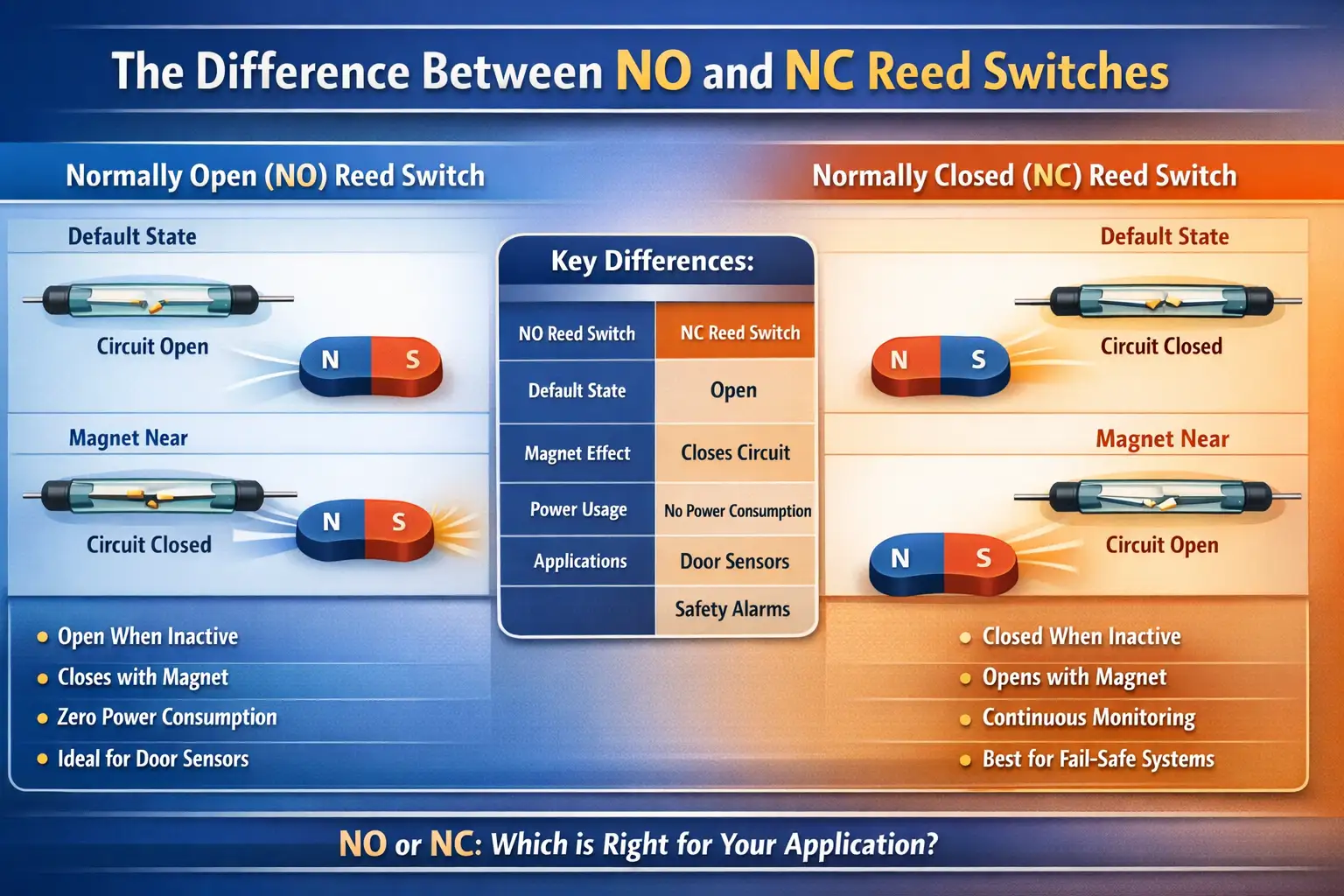
A Normally Open (NO) reed switch is one where the electrical circuit remains open by default. This means no current flows through the switch when no magnetic field is present. As soon as a magnet approaches, the magnetic field causes the reeds to attract each other. Once they touch, the circuit closes, enabling current to flow. When the magnet is removed, the reeds separate again and the circuit returns to its open state. NO reed switches therefore act like sensors that activate only when a magnet or magnetic field is detected.
NO reed switches are hugely popular over a huge range of industries because they consume no power in their idle state. This makes them particularly useful for battery-powered devices, small gadgets, IoT applications, and wireless sensors. Their default open state also makes sure that circuits are activated only by a calculate magnetic action, which improves accuracy in presence detection applications.
How It Works
- Default State: The reeds are separated, and the circuit is open (no current flows).
- Activated State: When a magnetic field is applied, the reeds move together, closing the circuit and allowing current to flow.
- Behavior: The switch only conducts electricity when a magnet is present.
Applications
- Door and window security sensors
- Industrial proximity detection
- Smart home devices and automation
- Battery-operated electronics
- Automotive systems such as brake indicators and door-open sensors
Advantages
- Zero power consumption in default state
- Highly reliable for magnetic presence detection
- It have Long lasting life with low maintenance
- Very Simple to install and integrate into circuits
Limitations
- Requires magnet presence for its activation
- Not suitable for systems requiring default ON conditions
- Not too much ideal for fail-safe applications
Normally Closed (NC) Reed Switch
Definition
A Normally Closed (NC) reed switch works exact in the opposite way. When it is in its default state, the reeds remain in contact, allowing current to flow continuously. This means the circuit stays closed unless a magnet comes close. When the magnetic field reaches the switch, the reeds repel or move apart, causing the circuit to open and stopping the current flow. Once the magnet moves away, the reeds return to their touching position, restoring the conductivity. NC reed switches are therefore ideal for applications that require a circuit to remain active by default and deactivate only in the presence of a magnetic field.
Because NC reed switches keep the circuit closed unless it is disturbed, they are especially suitable for critical safety systems, fail-safe designs, and monitoring devices. For example, if someone try to tamper with a secured object, remove a cover, or separate the magnet from the switch, the circuit immediately opens and triggers an alarm button. This makes NC reed switches highly valuable in ATMs, cash safes, industrial machinery, medical devices, and emergency systems. Their default ON nature makes sure that any type of interruption, whether due to failure, tampering, or accidental displacement , can be detected quickly.
How It Works
- Default State: The reeds are in contact, and the circuit is closed (current flows).
- Activated State: When a magnetic field is applied, the reeds move apart, opening the circuit and stopping current flow.
- Behavior: The switch conducts electricity until a magnet is present.
Applications
- Highly used in Fail-safe security and alarm systems
- Also Recommendable in Tamper detection devices
- In The Medical monitoring equipment
- Lift and elevator interlock mechanisms
- In The Industrial machine safety covers
Advantages
- It is Best for safety-critical applications
- Makes sure the continuous monitoring
- Ideal for systems requiring default ON state
- Highly reliable in detecting absence of magnetic field
Limitations
- It Consumes more power in default state
- It Is Usually more expensive than NO switches
- Requires precise installation for accurate fail-safe function
Key Differences Between NO and NC Reed Switches
Feature | Normally Open (NO) | Normally Closed (NC) |
|---|---|---|
Default State | Open (no current flow) | Closed (current flows) |
Magnetic Field Effect | Closes the circuit | Opens the circuit |
Power Consumption | No power in default state | Consumes power in default state |
Common Applications | Door sensors, proximity detection | Fail-safe systems, tamper detection |
Fail-Safe Suitability | Less suitable | Highly suitable |
⚠️ Pro-Level Insights: Avoiding Costly Mistakes
While reed switches might seem interchangeable, choosing the wrong one can lead to “ghost” alarms or dead batteries. Here is the “insider” truth every designer needs to know:
The “Cut-Wire” Security Secret: If you are building a security system, using an NO switch is a rookie mistake. Why? If an intruder simply cuts the wires to your sensor, the circuit stays open, and the alarm never sounds. Always use NC for security; a cut wire breaks the circuit and triggers the alarm immediately.
The Battery Killer: Integrating reed switches into IoT or battery-powered devices? An NC switch consumes power to stay “closed” in its idle state. For a device that needs to last years on a single coin cell, NO is the only way to go.
- Magnetic Interference: In industrial settings, nearby heavy machinery can create “stray” magnetic fields. NC switches are generally more “fail-safe” here because they require a deliberate, strong magnetic force to break the contact, reducing the chance of accidental triggers.
NO vs NC Reed Switch — Which One Should You Choose?
Choosing between an NO and NC reed switch depends hugely on the nature of your application. If the system requires activation only when a magnetic field is present for example, detecting whether a door is closed, triggering a light upon opening a cabinet, or turning on a device only when a lid is shut then the NO reed switch is an ideal choice. It makes sure that the circuit remains inactive until the magnet comes close, making it excellent for event-based functionality and periodic operation.
On the other hand, if your design requires continuous monitoring, or if you need the system to trigger an alert when something goes wrong or when a component is moved from its position, then an NC reed switch becomes important. Devices such as ATMs, industrial safety covers, medical equipment, and emergency systems depends heavily on NC switches because their default ON state helps in detect the faults quickly. Safety-related applications generally prefer NC switches because even a broken wire or accidental disconnection will break the circuit and signal a problem.
Power consumption is another important factor. Battery-powered devices work best with NO reed switches, while mains-powered systems can use NC switches more comfortably. Environmental conditions like vibration and shock also influence the selection. High-vibration environments may prefer NC switches since they maintain contact more reliably without any false activations.
Examples And Uses Of Magnetic Reed Switches In Daily Life
In home security systems, NO reed switches are mounted on doors and windows to detect openings. When the magnet separates from the switch, the circuit breaks and alerts the system. In contrast, highly sensitive equipment like cash safe lockers, industrial control units, and premium security boxes use NC reed switches to detect even the minor tampering attempts. Elevators are highly depends on NC reed switches for making sure the door safety; the elevator will not move unless the NC circuit is complete and the doors are securely closed.
Medical devices often merge with NC switches in their monitoring systems because an open circuit may show a malfunction or interruption. Smart home devices like water purifiers, cabinets, and refrigerators also commonly use reed switches, with the selection depending on whether activation should happen by presence or absence of a magnet.
Reed Switch Solutions by 1 LEAP Technologies
Companies like 1 LEAP Technologies plays an important role in providing an advanced reed switching and sensing solutions that meet today’s industry standards. Their reed switches range includes high-quality magnetic reed switches, advanced proximity sensors, and reliable automation components used over furniture manufacturing, security systems, industrial equipment, and smart devices. Their switches are known for consistent magnet response, accurate AT ratings, strong glass encapsulation, and long operational life, making them a trusted choice for industries requiring dependable magnetic sensing technology.
Conclusion
Understanding the difference between NO (Normally Open) and NC (Normally Closed) reed switches is important for selecting the right component for your application. NO reed switches are perfect for event-triggered and low-power applications, while NC reed switches are best in fail-safe designs and continuous monitoring systems. Each type has its own set of strengths and limitations, and the correct choice makes sure the both functional accuracy and safety. As industries move toward smarter, safer, and more automated environments, reed switches continue to remain one of the most reliable, cost-effective, and versatile sensing technologies available. With high-quality products from companies like 1 LEAP Technologies, engineers and manufacturers can implement reed switches with full confidence in their performance, durability, and long-term reliability.